
The right polo glove sits between your hand and everything that matters on the field, the mallet you swing and the reins that steer a pony at full gallop. This guide replaces the marketing fluff that dominates polo retail with a structured, decision-ready framework: which type to buy, what materials actually matter, how to size correctly, how to care for the leather, and which 2026 innovations are worth paying for.
By the end, you will know, with conviction, whether to spend £30 on a single right-hand glove or £195 on a carbon-fibre pair, and why.
1. What makes a polo glove different from any other glove
Polo is the only mainstream equestrian sport whose hands perform two completely different jobs simultaneously, under a rule that forbids switching them. The USPA (United States Polo Association) codifies this in Rule 28-e, and the Hurlingham Polo Association uses parallel language: the right hand holds the mallet; the left hand controls the reins. That single constraint shapes every design decision in a polo-specific glove.
The right hand drives the mallet through eight chukkas of swings – the palm, thumb pad and index finger absorb torque, vibration and grip wear.
The left hand holds two sets of reins continuously for 7-minute chukkers. It needs friction relief between the index and middle fingers, where smooth leather or rubber reins saw across the skin.
This is why purpose-built polo gloves are asymmetric: the left glove is engineered for rein friction; the right for mallet grip and durability. Generic golf gloves (single-hand, no rein reinforcement), motorcycle gloves (too rigid for fine rein feel) and standard equestrian riding gloves (no mallet-zone reinforcement) all fail at least one of these jobs.
Three distinguishing features of polo gloves
1. Anatomically cut so the hand sits naturally around a mallet grip.
2. A wide wrist strap with Velcro® closure – Ona uses an “inverse closure mechanism” that pulls across rather than into the palm, eliminating exposed skin near the pinky.
3. Knuckle and finger protection ranging from neoprene padding through to carbon fibre inserts – a response to the high incidence of hand impacts from ride-offs, hooked mallets and polo balls that can reach 110 mph during play.
2. The types of polo gloves on the market today
Polo gloves come in full-finger only – half-finger styles are essentially absent at the professional level because finger-tip protection from rein abrasion and ball impact is too valuable to sacrifice. The meaningful segmentation runs along three axes.
a) By protection level
| Tier | What It Offers | Representative Models | Who It’s For |
| Grip-only / Lightweight | Textured leather or synthetic palm, mesh back, no padding | Ona Speed XT, Heritage Tackified, MacWet, Franklin Pro Classic, Krono, Casablanca, Prisa Shizo | Players who prioritise feel, comfort, breathability and positive grip above all else |
| Medium Protection | Light knuckle/finger padding/TPU padding | Ona Power, Heritage Polo Pro, Franklin Pro Polo | Players who want the confidence of impact protection with full freedom of movement |
| Maximum Protection (Carbon) | Carbon-fibre inserts across knuckles, index finger and thumb | Ona Carbon Pro V2, Franklin Carbon Fibre Pro | Players who want the highest level of hand protection available – regardless of level or experience |
b) By weather specialisation
Dry/Humid Breathability-first construction – perforated fingers, fine-mesh backs and moisture-wicking materials for players who prioritise ventilation and feel above all else. Examples: Casablanca Performance, Ona Speed XT, Prisa Shizo A20, Ona All Weather V2 (peccary-embossed leather engineered for varying conditions).
Wet / All-Weather Water-repellent treated leather or hydrophobic synthetics that maintain grip integrity when conditions deteriorate. Examples: Ona All Weather Storm, MacWet, Heritage Tackified, Krono.
Eco / Sustainable The newest segment in polo glove design. Recycled microfibre construction combined with phase-change material mesh for temperature regulation. Examples: Ona EcoGrip with EcoSuede™.
“Most modern polo gloves are designed to perform across a range of conditions – these categories reflect primary design intention rather than strict limitations. A wet-weather glove can be worn in dry conditions; a breathability-first glove may perform perfectly well in light rain. The choice always comes back to personal preference and how the glove performs for the individual player.” – Alejandra Falkinhoff
c) By hand orientation
Right-hand-only is the most common entry point. Logical because the mallet hand does the most work. Pair (left + right) for players who want consistent rein feel and protection from reins friction. Left-hand-specific sold separately is rare – Ona, Heritage and Franklin sell singles (Right Hand only) to replace a worn glove without buying the pair.
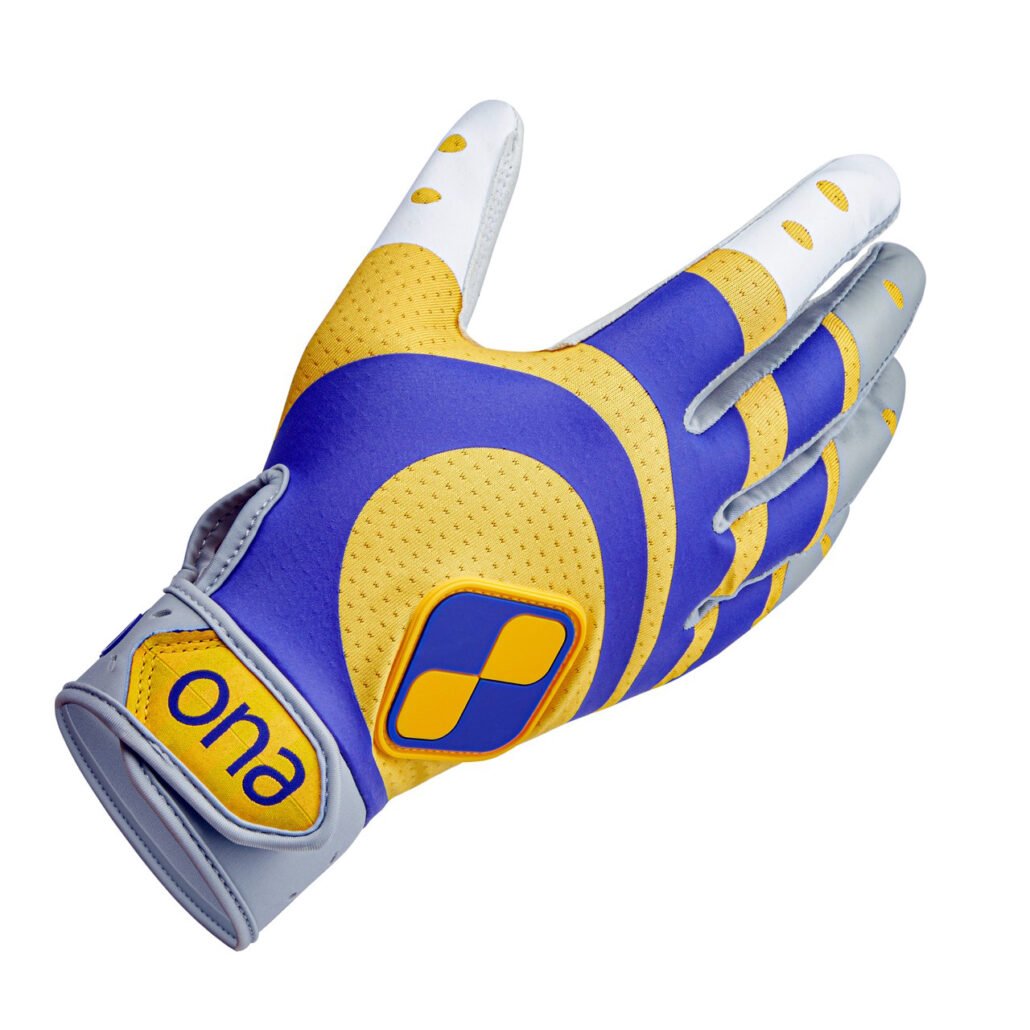


3. Materials: The anatomy of a polo glove
Material is where premium and entry-level brands genuinely diverge – not in marketing but in measurable grip and longevity.
Cabretta leather
Sourced from hair sheep (mostly Brazilian/Ethiopian), cabretta is the gold standard for sports gloves because it is naturally thin (0.4–0.7 mm) yet tensile, with a tight grain that breathes through micro-pores. Expect cabretta gloves to mould to your hand within 2–3 chukkas and maintain “second skin” feel for a season with care.
Goatskin
Goatskin is slightly thicker than cabretta but extremely abrasion-resistant, with a natural lanolin content that keeps it supple. “Tackified” or “digital” goatskin has been textured or chemically treated to amplify grip – Heritage’s tackified digital goatskin is widely cited as a high-friction surface for mallet control.
Pittards WR100X performance leather
Pittards is one of the world’s longest-standing technical-leather specialists, established in Yeovil, Somerset, in 1826. Their WR100X tanning process bonds water-repellent properties permanently into the fibre, allowing the leather to wick perspiration outward while resisting environmental moisture. Where ordinary leathers break down and become hard and brittle, Pittards’ WR100X leather retains its softness, feel and sensitivity through countless chukkas. Look for “Pittards” on the spec sheet – it’s the closest thing the industry has to a quality benchmark.
Pittards Atomic-texture leather with Gripster™ technology (Ona exclusive)
Pittards developed a grippier surface texture exclusively for Ona Polo. The “Atomic” finish raises micro-pyramids on the palm surface to maximise friction without becoming sticky when wet.
Synthetic suede / microfibre
Synthetic suede / microfibre – MacWet’s Aquatec™, Kronos’s HurricaneSuede™ and Ona’s EcoSuede™ are engineered microfibres that deliver excellent grip and feel in all conditions. Unlike natural leather, which varies in density across the hide, engineered microfibres are manufactured to a consistent thickness and texture throughout, giving precise control over grip pattern and performance. Hydrophobic variants repel water and dry quickly, maintaining grip integrity where leather can lose shape when wet. Resistant to salt from sweat – one of the primary causes of leather degradation – they are lightweight, breathable, machine washable and colour stable throughout their lifespan.
Ultimately the choice between leather and synthetic comes down to personal preference – how the glove feels, how it performs in terms of grip, and how well it suits an individual’s style of play. There are no rules. What is consistent is that synthetic gloves do behave better in very wet conditions, where natural leather can lose performance – and even players who prefer leather will often reach for synthetic when the weather demands it. For amateur players, a good pair of synthetic gloves can comfortably last an entire season and beyond with proper care, making them a practical and high-performing choice for most players. – Alejandra Falkinhoff
Mesh panels, stretch spandex, TPU and carbon fibre
Almost all premium polo gloves now incorporate mesh inserts across the knuckles and back of hand for ventilation and flex. Carbon fibre and TPU (thermoplastic polyurethane) inserts represent the newest innovation in impact protection. Ona’s Carbon Pro V2 features carbon fibre inserts on the knuckles, index finger and back of thumb – the points most susceptible to impact – offering the highest level of protection available in a polo glove. For players who want meaningful protection with full freedom of movement, Ona’s Power glove uses TPU inserts – a lightweight, flexible polymer that absorbs and disperses impact while moving naturally with the hand. It sits between a standard glove and the Carbon Pro V2 in terms of protection, making it the choice for players who want the confidence of impact protection without the firmer feel of carbon fibre.
4. Key features players actually look for
When evaluating any pair, run this six-point checklist:
1. Palm grip surface. Textured cabretta (Pittards Atomic, Gripster™), Franklin’s digital, or tackified goatskin for leather; Aquatec™/ HurricaneSuede™ / EcoSuede™ for synthetic.
2. Rein-friction reinforcement on the left hand. Look for an extra leather panel or gusset between the index and middle fingers.
3. Mallet-friction reinforcement on the right hand. Reinforced thumb and index finger, often with a second leather layer at the thumb crotch.
4. Knuckle / impact protection. From neoprene padding (entry-level) through carbon-fibre inserts (premium).
5. Breathability. The back of the hand is where most breathability engineering takes place – open mesh panels, perforation patterns and ventilated finger construction allow heat and moisture to escape during intense play.
6. Wrist closure and support. Wide Velcro® cuff with an “inverse” closure direction. A tight, supported wrist is the difference between mallet control and mallet slippage.


5. How polo gloves should fit (and the mistakes to avoid)
Polo gloves should fit like a second skin: snug across the palm with no excess material at the fingertips, but flexible enough to close fully around a mallet grip without pinching. That said, fit is one of the most personal decisions in a player’s kit. While a snug fit is the general starting point, some players prefer a closer next-to-skin feel while others play better with a little more room.
“There is no single rule – what matters above all else is that the glove feels comfortable and secure, and gives the player complete confidence in their grip. The fit has to adapt to the style and preference of the individual player, not the other way around.” – Alejandra Falkinhoff
How to measure your hand
Use a fabric/tailor’s tape measure (not metal). Lay your dominant hand flat, fingers together. Wrap the tape around the widest part of your palm – just below the knuckles – excluding the thumb. Note the circumference in both inches and centimetres. As a secondary check, measure from the base of your palm to the tip of your middle finger.
Polo glove size chart
| Glove Size | Hand Circumference (in) | Hand Circumference (cm) |
| XS / 6 | 6.5–7.0 in | 16.5–17.8 cm |
| S / 7 | 7.0–7.5 in | 17.8–19.0 cm |
| M / 8 | 7.5–8.0 in | 19.0–20.3 cm |
| L / 9 | 8.0–8.5 in | 20.3–21.6 cm |
| XL / 10 | 8.5–9.0 in | 21.6–22.9 cm |
| XXL / 11 | 9.0–9.5 in | 22.9–24.1 cm |
Always cross-check the brand’s own size chart. Ona Carbon Pro V2 wearers often size up one because the carbon knuckle panel doesn’t stretch.
The five most common sizing mistakes
1. Assuming sizing is universal across brands – always check each brand’s sizing guide.
2. Not breaking in a leather glove before competition. Leather needs a few practice chukkas to reach its optimal point of wear and feel. Synthetic gloves require no break-in period and can be worn straight out of the bag.
3. Measuring the wrong hand – always measure your right.
4. Going too roomy – excess material creates friction and discomfort during play.
5. Not accounting for protection level – carbon protection gloves require sizing up due to the rigidity of the inserts.
6. What 25 years of player feedback tells us about glove choice
Every player’s relationship with their glove evolves. What works in your first season rarely looks the same five years later – and that’s exactly as it should be.
Newcomer
At this stage the priority is simple: confidence. Soft hands learning to hold both mallet and reins, combined with the nerves and physical demands of early play, mean grip and breathability matter most. Gloves don’t need to be premium but they do need to perform – a well-made synthetic pair that washes easily and delivers consistent grip is the smartest starting point.
Club Player
By this stage a player knows what they like. They have found their brand, understand how a glove should feel and are starting to think about conditions. Better gloves are kept for tournaments, older pairs go to practice, and a wet weather pair begins to make sense. Rotation becomes part of the routine.
Competitive Player
At this level the choice is entirely about performance consistency and familiarity. Competitive players know exactly what they want from a glove – how it feels, how it performs and how it holds up under pressure. They rotate across conditions and carry plenty of pairs. The glove has become a tool they trust completely, and that trust has been built over years of play.
7. Climate and weather: Matching the glove to the conditions
Polo is played internationally – from Argentina and Australia to the UK, the USA, the Middle East and beyond. Most players wear their preferred glove regardless of where in the world they are playing. The exception worth noting is wet conditions, where synthetic gloves generally outperform leather as we covered earlier. In extreme cold such as snow polo – most notably at St Moritz and Aspen – some players opt for winter gloves altogether, while others still keep their regular polo glove to retain feel.
8. Construction details that separate premium from entry-level
Open up the spec sheet on any premium polo glove and you’ll see four construction details that matter:
1. Stitching. Double-row stitching at the palm seams, thumb crotch and finger gussets. Single-stitched gloves fail at exactly the points polo loads hardest.
2. Closure. A single Velcro® wrist strap is standard across the industry. The direction of closure matters more than most players realise. The traditional closure runs from the pinky side toward the thumb, which leaves an exposed eyelet area on the palm directly opposite the pinky – creating movement and discomfort exactly where the hand needs full contact with the mallet. Ona’s inverse closure mechanism solved this problem, reversing the direction so the palm sits flush and stable against the mallet throughout play.
3. Palm reinforcement zones. Look for visible second-layer panels at: thumb pad (right hand), thumb-to-index crotch (both hands), middle and index finger pads (left hand for reins; right hand for mallet shaft).
4. Cuff construction. well-constructed cuff of around an inch in width provides light wrist stabilisation and ensures the glove sits securely without riding up during play.
9. Care and maintenance: How to make a polo glove last a full season
Polo gloves are a natural consumable – but with the right care, their useful life can be extended significantly.
After every match
Wipe down with a dry towel to remove sweat and dust before they soak into the leather. Gently reshape each finger and the palm back into shape. Air dry away from direct sunlight, heat sources and never leave them in a kit bag or in a hot car.
Washing
Leather is a natural product and will inevitably deteriorate with sweat over time – that is simply the nature of the material. Only wash when the gloves have become visibly soiled. Make a solution of lukewarm water with a very mild detergent, clean thoroughly to remove all dirt, rinse well to remove all soap residue and air dry in a dark place away from direct sunlight. Synthetic gloves can be machine washed on a cold delicate cycle without issue. Air dry only – never tumble dry.
When to replace your polo gloves
Leather gloves will harden with age and show clear signs of wear on the palm and pressure points. Stitching may come undone – minor repairs are possible, but they are a sign the glove is ageing and no longer performing as it should. The best approach is to retire them to practice use while they still have some life in them and invest in a new pair for match play. There is little value in letting a glove deteriorate to the point where it is no longer useful at all.
10. The polo glove market today
The most significant change in recent years is not design innovation – it is market growth. There are considerably more brands available today than a decade ago, which gives players a much wider range of price points and styles to choose from when finding a glove that suits their needs and budget.
In terms of genuine design innovation, however, the category has remained relatively static. Ona remains the only brand producing eco gloves with recycled microfibre construction – a development that has yet to be widely adopted across the industry.
What the growth in competition has delivered is accessibility. Players at every level and budget can now find a well-made polo glove where previously the options were more limited. The trade-off is that many newer entrants follow established designs rather than advancing them – so while choice has increased, the fundamentals of what makes a great polo glove have not changed.
11. Buying decision framework
The right glove is always the one that works for you – but the following is a practical guide based on where you are in your polo journey.
Newcomer. Your priority is confidence – in your grip on the mallet and your feel on the reins. A well-made synthetic glove in your correct size is the smartest starting point: it requires no break-in, washes easily and delivers consistent grip from the first chukka. Wear both gloves.
Club Player. By this stage you know what you like and have likely found your brand. Your glove selection will naturally start to expand – better gloves kept for tournaments, older pairs for practice, and a wet weather option as conditions demand. This is the stage where investing in quality pays back most noticeably in feel, fit and longevity.
Competitive Player. At this level the glove is a trusted tool. Competitive players know exactly what they want, rotate across conditions and carry multiple pairs. The focus is entirely on performance consistency and familiarity – a glove that works with them rather than against them in every situation the game presents.
Whatever your level, invest in quality where it matters most – the glove is the only point of connection between you, the mallet and the reins. There are plenty of brands on the market today across a wide range of price points. Take the time to shop around, try different styles and sizes where possible, and do your research – it will pay off. Get the right glove and everything else follows.
“Choosing a polo glove is a more considered decision than it might first appear. Feel, fit, material, construction and protection all play a role – and none of them can be separated from the individual player making the choice. After 25 years designing and manufacturing polo equipment, the one thing I have learned above all else is that there is no single right answer. The best polo glove is the one that gives you complete confidence in your grip, moves with your hand naturally and lets you focus entirely on the game. Everything else is detail.”- Alejandra Falkinhoff


12. Frequently asked questions
Do polo players wear gloves on both hands or just one?
Both are common and both are perfectly valid. Some players prefer the feel of a bare hand on the reins; others wear both for comfort, grip and protection. As with most things in polo, it comes down to personal preference.
Do I need different gloves for each hand?
Not necessarily, though the demands on each hand are different. The right hand holds the mallet and needs positive grip and control; the left hand manages the reins and benefits from protection against rein friction and burn. Some players choose different gloves for each hand accordingly, others wear a matching pair. A clear example is the SSG roping glove, which some players wear on their left hand to reduce friction from the reins.
Can left-handed players hold the mallet in the left hand?
No. Under official rules, all players must hold the mallet in the right hand regardless of natural handedness. Left-handed players need exactly the same right-hand mallet glove as everyone else.
What is the difference between leather and synthetic polo gloves?
Leather moulds to the hand over time and delivers exceptional feel and feedback. Synthetic gloves require no break-in period, are easier to care for and outperform leather in wet conditions. Beyond that, the choice comes down to personal preference – there is no universal rule about which is better.
How do I know what size polo glove to buy?
Ona gloves are sized XS, S, M, L, XL and XXL. Sizing is not universal across brands – a player who is a medium in one brand may be a large in another. Where possible, try before you buy at a local tack shop. If buying online, order two sizes and return what doesn’t fit – most reputable brands will accommodate exchanges and/or refunds.
Do I need to size up for carbon protection gloves?
Yes. The rigidity of carbon fibre inserts means there is less stretch and give in the construction than a standard glove. Players should size up when moving to a carbon protection glove to ensure the hand can close comfortably around the mallet without restriction.
How long do polo gloves last?
It depends entirely on how often you play and how well you care for them. A professional competing internationally may go through multiple pairs in a season; an amateur playing regularly can expect a well-maintained pair to last a full season and beyond. The key is proper care after every match and knowing when to retire them to practice use before they deteriorate completely.
When should I replace my polo gloves?
When the leather has hardened, the palm shows clear signs of wear, or stitching has come undone. A glove past its best will affect your grip and your feel – retire it to practice while it still has some life left and invest in a fresh pair for match play.
Are polo gloves the same as other sports gloves?
No. Polo gloves are specifically engineered for the demands of the sport – grip on a mallet, feel through the reins, and in premium models, impact protection at the points most vulnerable to mallet and ball contact. No other sports glove addresses this combination of requirements.
How should I care for my leather polo gloves?
After every match, wipe down with a dry towel, reshape the fingers and palm and air dry away from heat and direct sunlight. If they become visibly soiled, wash gently in lukewarm water with a mild detergent, rinse thoroughly and air dry in a cool dark place. Never leave them in a kit bag or a hot car.