
A polo ball weighing just over 100 grams can reach speeds of up to 110 mph during play. At that velocity, it covers the distance between two players in a fraction of a second. And while the ball itself is too large to fully enter the eye socket, that doesn’t make it safe: on high-speed impact the ball deforms, and a portion of it can still reach the globe with enough force to cause serious injury, even as the surrounding bone absorbs some of the blow.
That risk is borne out in the data. A 2025 peer-reviewed study in the Postgraduate Medical Journal (1) found that eye injuries are the most common reason a polo player ends up needing hospital treatment, more than limb injuries, more than head and face injuries of any other kind. The HPA has responded by making eye protection mandatory for all players as of 2026; the USPA still treats it as optional for adults, requiring it only for players under eighteen.
This guide makes the case for wearing purpose-built polo eyewear on every chukka, explains the polo lens technologies that matter, compares the leading polo-specific brands, and walks through how to choose the right pair for your playing conditions, face shape and helmet.
1. Why eye protection matters: What the data shows
1.1 The headline statistic
Eye injuries account for 45.5% of all polo injuries requiring hospital treatment , Eye injuries account for 45.5% of all polo injuries requiring hospital treatment , the highest percentage of any body region. This is the central finding of a 2025 study published in the Postgraduate Medical Journal (Oxford Academic), which analysed 236 injured players across 26 English polo clubs between 2018 and 2024. The study found that while limbs were the most frequently injured site overall (47.9%), eye injuries were disproportionately severe: nearly half required hospital care, compared with 36.9% for limb injuries and 35.4% for other face and head injuries.
The study’s conclusion is unequivocal: “As helmets are already mandated while playing polo, we now advocate the compulsory use of eye protection (sports glasses, goggles or face guards) for all polo players.”
1.2 How players sustain eye injuries
Direct ball strike: a polo ball is approximately 9cm in diameter , too large to fully enter the eye socket, but on high-speed impact the ball deforms and a portion of it can still strike the globe directly. At up to 110 mph, the kinetic energy involved is sufficient to cause orbital fracture, retinal detachment or globe rupture.
Mallet contact: a swung mallet head at the end of a 48–54 inch shaft generates enormous force. Glancing contact with the face or orbital area during a ride-off or hook is a documented cause of serious facial and eye injury.
Flying divots and debris: turf, grit and sand kicked up by galloping hooves are the most common minor eye irritant. On dry, sandy pitches the volume of airborne debris is considerable.
UV and glare: chronic UV exposure over long outdoor matches is a well-established risk factor for cataracts and pterygium, and may also contribute to macular degeneration, though that link is less firmly established than the others. Acute photokeratitis (“sunburn of the eye”) causes temporary but painful light sensitivity.
Horse-related trauma: falls, kicks and contact with the horse’s head. The PMJ study found that among horse-related injuries serious enough to require hospital treatment, the eye was the most common site, accounting for two-thirds of cases , though the sample behind that figure is small, so it’s worth treating as indicative rather than precise.
1.3 Types of eye injury in polo
| Injury Type | Description and Severity |
| Corneal abrasion | Scratch on the cornea’s surface from grit, debris or glancing contact. Extremely painful (the cornea has hundreds of times more pain receptors than skin). Usually heals in 1–7 days but can become infected. |
| Hyphema | Blood pooling in the front chamber of the eye from blunt impact. A medical emergency that can lead to glaucoma, cataract and permanent vision loss. |
| Orbital fracture | A break of the thin orbital floor or wall from a ball or elbow strike. Hallmark signs: double vision, sunken eye, facial numbness. May require surgery. |
| Retinal detachment | The retina pulls away after blunt trauma. Sight-threatening; can present days, months or years later with flashes, floaters or a “curtain” over vision. |
| Foreign body | Grass, mud, sand or stick fragments lodged on or in the eye. Penetrating intraocular foreign bodies can be deceptively painless because the vitreous and retina lack nerve endings. |
| UV damage / photokeratitis | Acute “sunburn of the eye” from glare. Red, gritty, light-sensitive eyes; resolves in 1–2 days. Chronic exposure raises cataract risk. |
Beyond the published data, the real-world evidence is just as direct. Ona’s founder hears it from players themselves.
“Players call me afterwards and say, ‘you saved my eye.’ That feeling never gets old. But there’s a paradox in all of this , it almost always takes witnessing an injury, your own or someone else’s, before people really understand how serious this is. The decision to wear proper protection shouldn’t wait for that moment, and it shouldn’t be made by thinking with your wallet. It’s a decision to make with a cold, clear head, not based on price.” – Alejandra Falkinhoff, founder of Ona
2. Rules and regulations on eye protection
Eye protection in polo has moved unevenly between governing bodies: some have already made it mandatory, others still treat it as optional but strongly encouraged, and a few apply the mandate only to younger players.
HPA (UK, Ireland and affiliated nations): as of 2026, the HPA’s Helmet and Eye Protection Regulations make face/eye protection mandatory for all players during play, satisfied by sports glasses, goggles or a face guard. This followed directly from the recommendation made by the 2025 PMJ study, making the HPA the first major governing body to act on it.
USPA (United States): USPA Outdoor and Arena Rules strongly encourage players to wear eye protection at all times during play, but it is not mandatory for adults. Eye protection is mandatory for all players under the age of eighteen, and this rule is written identically into both the Outdoor and Arena rulebooks.
AAP (Argentina): the AAP’s rules explicitly require under-18 referees to wear protective glasses alongside a helmet when officiating. I could not independently confirm an equivalent rule applying to players under 18 rather than referees , this is worth verifying directly with the AAP rulebook before stating it as a player rule.
SUPA (UK university polo): currently recommends eye protection for all players. I wasn’t able to verify a public statement of plans to make it mandatory , worth confirming directly with SUPA before including that claim.
Individual clubs and tournaments: some clubs and tournament committees mandate eye or face protection as a local rule, particularly for arena polo, where the enclosed space and board-bounced ball increase the risk of unpredictable impacts.
The regulatory picture is no longer simply “moving toward mandatory” , it has already arrived for the HPA. The 2025 PMJ study provided the evidence base, and the HPA acted on it within roughly a year. Players under USPA, AAP and SUPA jurisdictions who adopt eye protection now are ahead of rules that may well follow the same path the HPA has already taken.
3. What makes polo eyewear different from regular sunglasses
Polo eyewear is not a fashion accessory , it is sports-grade protective equipment, at least when it’s built to the standard the best brands set. The difference between purpose-built polo eyewear and a pair of fashion sunglasses is the difference between a polo helmet and a top hat: one is engineered to absorb impact, the other is not.
3.1 Impact resistance
Polo-specific lenses are made from polycarbonate , a thermoplastic that is approximately 10 times more impact-resistant than standard plastic (CR-39) or glass, roughly 250 times stronger than standard glass, and about 50% lighter. Polycarbonate flexes and absorbs energy on impact rather than shattering into shards. Fashion sunglasses typically use CR-39 or glass lenses, which can fracture into sharp fragments on a direct strike , turning a ball or mallet impact into a penetrating eye injury.
3.2 Wraparound design
Good polo eyewear should use a wraparound shield geometry that provides lateral peripheral coverage, blocking wind, dust and divots from angles a flat-fronted fashion frame leaves completely exposed. In practice, the degree of curvature varies by brand: Ona’s frames range from a Base 6 curve (AELOX) up to Base 7 (VCP21), while other polo-specific brands on the market typically sit at a lower curve, closer to Base 5. A higher base curve isn’t just a styling choice , the tighter wrap reduces the gap between lens and face, which is where wind, dust and lateral impacts get through on flatter frames. Either way, the wraparound shape is what allows the frame to stay seated during fast riding and sudden head movements, something no flat fashion lens can do regardless of its base curve.
3.3 Anti-fog and ventilation
Body heat rises rapidly during a chukka, and a galloping horse creates airflow that can alternate between cool headwinds and warm thermals. Fog forms when warm, moist air from the rider’s face hits the cooler lens surface. The best polo eyewear addresses this with hydrophilic or hydrophobic coatings and strategically placed frame vents; not every polo-specific frame on the market includes this engineering, but it’s increasingly the benchmark premium brands are building toward. Fashion sunglasses have no anti-fog engineering at all and will fog within minutes of sustained riding.
3.4 UV protection
All polycarbonate lenses inherently block 100% of UV radiation (UV400 , covering both UVA and UVB). This is a material property, not a coating, so it cannot wear off over time. Fashion sunglasses with cheap tinted plastic may darken the visual field without actually filtering UV, which is worse than no sunglasses at all: the pupil dilates in the darkened view, admitting more unfiltered UV to the retina.
3.5 Retention systems
The best polo eyewear uses soft rubber nose pads (such as Ona’s Megol material), adjustable temple grips and, in some models, an elastic retention strap to keep the frame securely on the face during galloping, leaning and swinging. This level of retention engineering isn’t universal across polo-specific brands, but it’s the standard the category should be judged against. Fashion frames, by contrast, rely on friction alone and will slide or fall off within a single chukka.
3.6 Helmet compatibility
The frame profile must fit under a polo helmet brim without being pushed into the face or creating pressure points at the temples. This requires low-profile temples and controlled frame depth , a design constraint that fashion sunglasses aren’t built to satisfy, and one that separates genuinely polo-engineered frames from eyewear that’s simply marketed for the sport.
“It took us several years to get our first protective polo eyewear, the VCP21, right. We went through round after round of samples, back to the drawing board more than once, lab testing and then testing with real players on the field , because vision and safety both had to be exactly right, and we weren’t going to release something that compromised on either.” – Alejandra Falkinhoff, founder of Ona

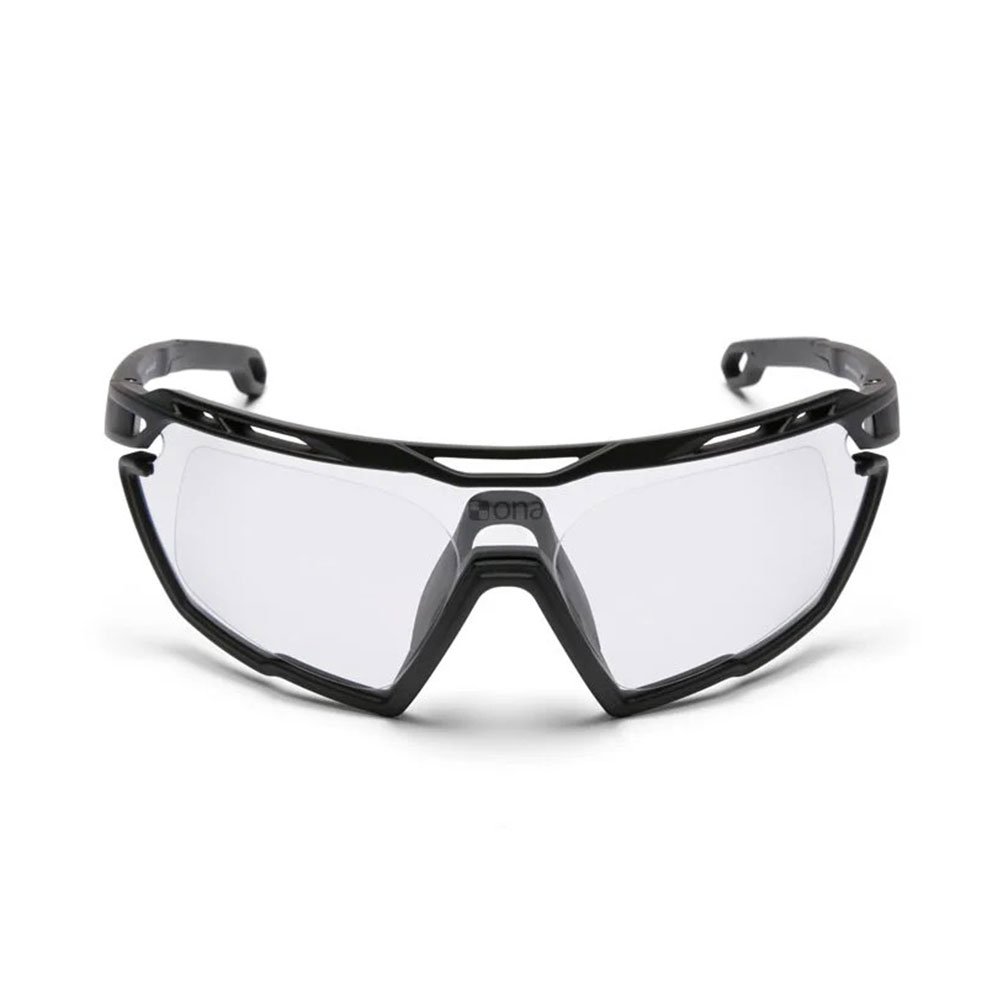
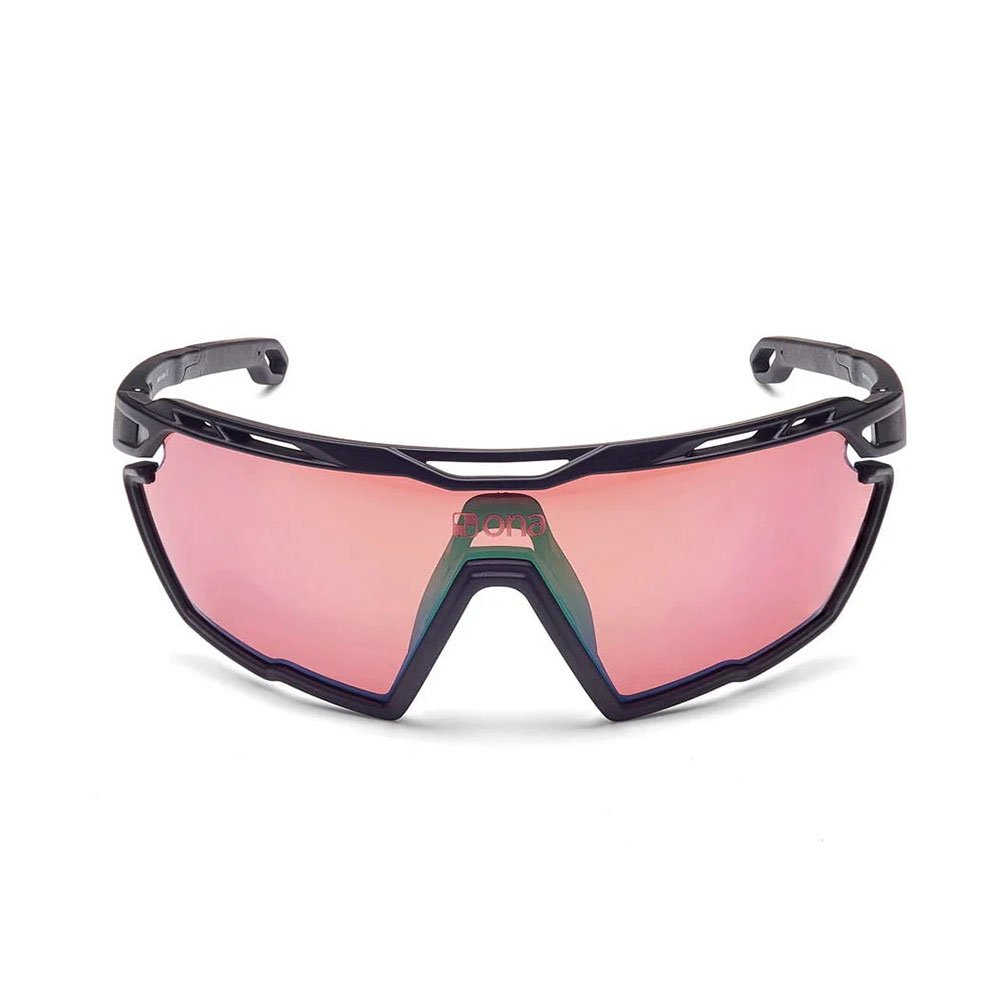
4. The Ona Polo eyewear range
Ona’s eyewear line spans two frame families , the flagship VCP21 and the newer AELOX , each available in standard and prescription (RX) configurations.
| Model | Lens | Certifications | Price | Best For |
| VCP21 | Pink/petrol mirror (cat. 2) + clear spare (cat. 0) | MIL-PRF-31013, ANSI Z87.1-2020, EN ISO 12312-1, EN166 Cat II | £398 | Maximum ballistic-grade protection. Variable conditions. |
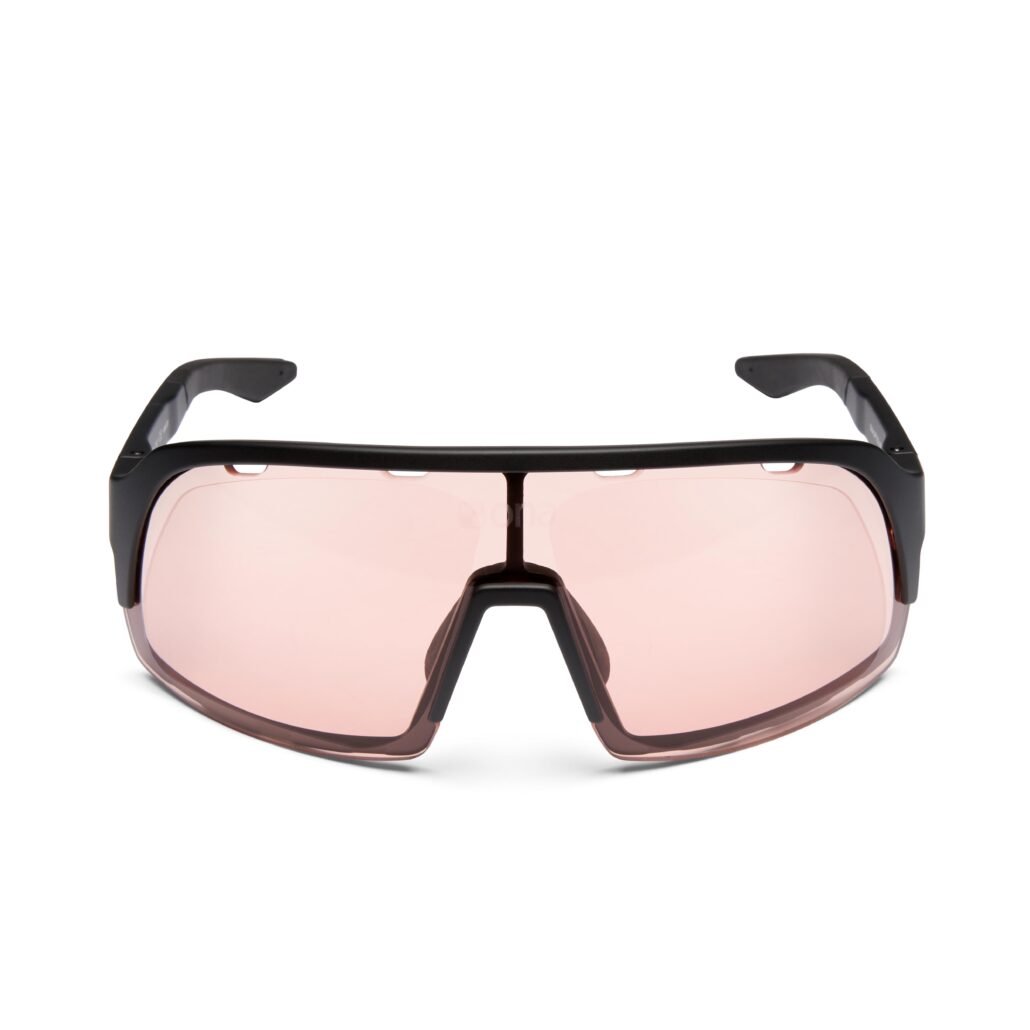
| AELOX PK | High-contrast pink (cat. 2, fixed) | ANSI Z87.1-2020, EN ISO 12312-1 | £248 | Overcast, variable and low-light play. Contrast and depth. |
| AELOX PH | Velocity Photochromic (cat. 0 ↔ cat. 3) | ANSI Z87.1-2020, EN ISO 12312-1 | £270 | Dawn-to-dusk versatility. One lens for all conditions. |
| AELOX RX | Prescription (single vision or progressive) | ANSI Z87.1-2020, EN ISO 12312-1 | £580–£948 | Players needing corrective lenses. |
| VCP21 RX | Prescription one-piece curved lens (MAXIMUS platform) | MIL-PRF-31013, ANSI Z87.1-2020, EN ISO 12312-1 | £580–£728 | Prescription players wanting ballistic-grade protection. |
Key technologies
Frame: Lightweight Military Grilamid TR90 (a flexible, shatter-resistant nylon). Megol rubber nose pads and adjustable temple tips for a secure, customisable fit.
Velocity photochromic: An internal-film technology that transitions from clear (Category 0) to dark grey (Category 3) and back, adapting to changing light conditions through a match. Positioned as one of the fastest photochromic systems available.
PANOR-X: Enhanced peripheral vision engineering for maximum field awareness.
Vibrance: High-contrast tint technology that amplifies depth perception and object definition , the science behind the pink lens option.
MAXIMUS: The proprietary prescription platform that integrates corrective oculars into a one-piece curved lens. Available in single vision and progressive, with a prescription range of +3.00 to −8.00D.
Coatings: Front and back super-hydrophobic + oleophobic treatment repels water, sweat, oils and fingerprints.
Important distinction: the VCP21 uses Zeiss Impacto lenses, a benchmark material for optical quality and vision science, and carries the military ballistic MIL-PRF-31013 rating in addition to ANSI Z87.1. The AELOX range is ANSI Z87.1 / EN ISO 12312-1 certified but is explicitly not rated for ballistic or industrial use. Both provide genuine sport-grade impact protection; the VCP21 provides the highest available tier.
5. Competitor polo eyewear brands
| Brand | Key Features | Certifications | Price Range |
| Krono Polo | Guard mask-style and TENFRAME models. Ships with 4 interchangeable lenses (clear, grey, red iridium, photochromic). UV400. | ANSI Z87+ | $187–$235 |
| Blueye (Polo Edge) | Developed with international player Glen Gilmore. Ultra-lightweight, vented polycarbonate, anti-fog, elastic clip/strap. Interchangeable lenses. | ANSI Z87.1 | $110 |
| Oakley (adapted) | Sport models (Jawbreaker, Radar) adapted for polo. Prizm lens technology for contrast. Not polo-specific but widely respected for optics. | ANSI Z87.1 | $175+ |
There is no polo-specific eyewear certification standard. All brands apply general sport and safety standards (ANSI Z87.1, EN 166, EN ISO 12312-1) or, in the VCP21’s case, the military ballistic standard MIL-PRF-31013. The VCP21’s ballistic rating is its primary differentiator in the competitive landscape.
6. Lens technology: A deeper look
6.1 Polycarbonate
Polycarbonate is the industry-standard lens material for all serious polo eyewear. Key properties: approximately 10× the impact resistance of CR-39 plastic or glass; roughly 250× stronger than glass; about 50% lighter than glass; inherently blocks 100% UV; high refractive index (1.586) allows thinner lenses. The primary downside is lower scratch resistance than glass, which is why a scratch-resistant hard coating is essential. These are properties of the material itself, not a certification , being made of polycarbonate doesn’t make a lens milspec. MIL-PRF-31013 tests the eyewear as a complete system: the frame and lens both have to remain intact under ballistic impact and repeated physical stress, with no fragments reaching the eye area. A lens can be genuinely impact-resistant without the frame holding up to that standard, which is why the rating applies to the whole VCP21 as built, not to the lens material in isolation, and why other genuinely impact-resistant polycarbonate polo eyewear doesn’t automatically qualify.
6.2 Photochromic lenses
UV-activated molecules embedded in or applied to the lens darken in sunlight and clear in shade. Current top-tier photochromic lenses reach full darkness in approximately 25 seconds and fade back in under two minutes. They are temperature-sensitive , they darken more and faster in cold weather and may not reach full darkness in extreme heat. Ona’s Velocity photochromic (AELOX PH) transitions between Category 0 (clear) and Category 3 (dark grey), making it the most versatile single-lens solution for polo played across variable lighting conditions.
6.3 Polarisation: why polo eyewear is typically non-polarised
Polarised lenses are excellent at cutting horizontal glare from water and wet ground. However, polarisation can flatten depth perception and slow ball tracking , a significant concern in a sport where judging the speed and distance of a fast-moving ball is critical. For this reason, most polo-specific eyewear uses non-polarised lenses. Players who primarily play near water or on consistently wet ground may benefit from polarised options, but the default recommendation for polo is non-polarised.
6.4 Lens tints and their functions
| Tint | Best Conditions | Function |
| Clear (Cat. 0) | Low light, dawn/dusk, arena | Maximum light transmission. Impact and debris protection without dimming. Essential for indoor/arena polo. |
| Grey (Cat. 3) | Bright sun | True colour reproduction with reduced brightness. The standard sunny-day option. |
| Pink / rose (Cat. 2) | Overcast, variable light | Amplifies contrast and depth perception. Enhances definition of objects against sky and turf. Ona’s Vibrance technology. |
| Amber / yellow (Cat. 1–2) | Very low light, dawn, dusk | Brightens the visual field and enhances contrast in flat, low-contrast lighting. |
| Photochromic (Cat. 0↔3) | Any and all conditions | Automatically adjusts from clear to dark. The dawn-to-dusk all-rounder. |
6.5 Coatings
Anti-fog: Hydrophilic coatings spread moisture into a thin, transparent film; hydrophobic coatings shed water and sweat. Frame venting completes the anti-fog system. Essential during physically intense chukkas.
Scratch-resistant: A hard coating over the softer polycarbonate surface. Critical because polycarbonate scratches more easily than glass.
Hydrophobic / oleophobic: Repels water, sweat, oils and fingerprints. Keeps the lens clean through a match.
Mirror: Multi-layer front mirrors reflect additional light and reduce veiling glare. The visible colour is largely cosmetic; the functional contrast work is done by the base tint underneath.
7. Prescription polo eyewear
Players who need corrective lenses have three practical routes:
1. Prescription polo eyewear (the ideal solution): Ona’s AELOX RX and VCP21 RX integrate the prescription into a one-piece curved polycarbonate lens that maintains the full wraparound protection and impact resistance of the standard frame. The VCP21 RX’s MAXIMUS platform offers single-vision and progressive options from +3.00 to −8.00D, with clear, coloured, photochromic and mirror-coating lens options. The prescription oculars are concealed from the outside.
2. Contact lenses under plano eyewear: A practical and popular alternative. Contact lenses can increase the peripheral field of vision by approximately 15% over spectacles and provide stable vision during fast head movement. The downsides for polo are real: wind and dust dry the eyes, debris can be trapped under the lens, and rigid gas-permeable lenses can dislodge. Best practice is to wear contacts under plano (non-prescription) impact-rated polo eyewear for physical protection.
3. Ordinary spectacles (not recommended): Standard glasses offer poor impact protection, an insecure fit during riding, and no peripheral coverage. In the event of a ball or mallet strike, glass or CR-39 lenses can shatter into the eye, compounding the injury. This is the least safe option.
8. How to choose the right polo eyewear
8.1 Fit and helmet compatibility
Always test the frame with your polo helmet on. Put the helmet on first, then the eyewear. Check for: no pressure point at the temples where the frame meets the helmet; no slippage when you shake your head vigorously; and clear, unobstructed vision when you drop into a riding and hitting posture. Choose a nose-bridge and Megol pad system that grips without pinching.
8.2 Lens selection by playing conditions
Consistent bright sun: Grey fixed-tint lens (Category 3) or the VCP21’s pink/petrol mirror (Category 2 with mirror coating for additional glare reduction).
Overcast or variable light: High-contrast pink or amber lens (AELOX PK, Category 2). These amplify depth perception and object definition when flat light makes ball-tracking difficult.
Dawn, dusk or evening chukkas: Clear or yellow lens (Category 0–1). Protection from debris without dimming the visual field.
All conditions / variable match-day lighting: Photochromic (AELOX PH, Category 0↔3). The single-lens solution when you don’t know what the light will do across four to eight chukkas.
Arena / indoor polo: Clear lens (Category 0). Arena lighting is controlled and generally lower than outdoor daylight; a tinted lens will reduce visibility unnecessarily. Impact protection remains essential because the ball bounces off boards at unpredictable angles.
8.3 Fixed-tint vs photochromic: the decision framework
Choose fixed-tint if you predominantly play in one lighting condition (e.g., consistently sunny Saturdays). Fixed-tint lenses are optically optimised for their specific category and are typically less expensive.
Choose photochromic if you play across variable conditions , dawn-to-dusk match days, travel between climates, or multiple chukkas that span changing light. One lens replaces two or three fixed-tint options.
9. Care and maintenance
Cleaning: Clean polycarbonate lenses only with a microfibre cloth and lens-cleaning spray (or lukewarm water with mild, lotion-free soap). Never use paper towels, tissues, shirt fabric or household glass cleaner , all of these will scratch polycarbonate.
Storage: Store in the hard case provided (Ona ships a zippered hard case with every pair). Avoid loose storage in a polo kit bag where mallets, spurs, bits and tack will scratch the lenses.
Anti-fog maintenance: Do not rub a dry, gritty lens , wet it first. Avoid abrasive cleaners that degrade hydrophobic and anti-fog coatings.
Heat exposure: Never leave any pair of polo eyewear under intense heat , on a hot car dashboard, in direct sun on a windowsill, or anywhere temperatures build up enclosed. This isn’t a minor durability issue: excessive heat can cause the lens films and coatings to delaminate or shatter outright, not just degrade performance. This applies to every lens type, not only photochromic models, where heat additionally shortens the lifespan of the photochromic molecules and reduces transition performance on top of the structural risk.
Replacement: Replace lenses when scratches distort vision or coatings degrade. Replace frames when flex, retention or nose-pad grip is lost. A well-maintained pair of premium polo eyewear should last 2–4 seasons.
10. Arena vs outdoor polo: Eyewear considerations
Outdoor (grass): High UV exposure, bright sun, a hard 9 cm plastic ball at speed, and airborne grit from hooves. Prioritise tinted or photochromic UV400 lenses with the strongest available impact certification.
Arena (indoor/enclosed): Lower UV, controlled artificial lighting, and a larger inflated leather ball. Choose clear or very light lenses (Category 0–1) to maintain visibility in the dimmer environment. Impact protection remains essential because the ball bounces off sideboards at unpredictable angles, and close-quarters contact increases the risk of mallet and elbow collisions.
All polo associations already mandate eye protection for all under-18 players in both arena and outdoor formats. SUPA has announced plans to make eye protection mandatory for all university-level players. Individual clubs can and do mandate it locally. The trend is toward universal adoption.
The evidence for wearing polo eyewear on every chukka is now overwhelming. Eye injuries are the single most likely reason a polo player will need hospital treatment , a finding from the largest study of polo player injuries to date. Purpose-built polo eyewear, when properly engineered, should combine polycarbonate construction with wraparound geometry, anti-fog coatings and a retention system built for the demands of mounted sport , addressing a risk that fashion sunglasses and bare eyes simply cannot. Not every polo-specific frame on the market meets that full standard, which is exactly why it’s worth checking construction, certification and base curve rather than relying on branding alone.
Across the leading brands, that standard shows up differently: ballistic-rated lenses for maximum protection, high-contrast tints for overcast play, photochromic lenses for dawn-to-dusk versatility, and wraparound curves ranging from Base 5 through Base 7 depending on the manufacturer. Whichever combination suits your playing conditions, face shape and helmet, the decision to protect your vision is one that pays dividends on every ride-off, every hooked mallet and every divot that flies past your face at speed.

Frequently asked questions
Do polo players wear eye protection?
Increasingly, yes. Eye protection is mandatory by the HPA and strongly encouraged by the USPA, and is mandatory for all USPA and AAP players under 18. Adoption among adult players is growing rapidly, driven by injury data showing eye injuries are the leading cause of hospital treatment in polo.
What sunglasses do polo players wear?
Purpose-built polo eyewear with polycarbonate lenses, wraparound frames, anti-fog coatings and UV400 protection. Leading polo-specific brands include Ona Polo, Krono Polo and Blueye. Regular fashion sunglasses , including Ralph Lauren “Polo” sunglasses , are not designed for sport and offer no meaningful impact protection. Oakley designs although not built specifically for the sport are commonplace in polo.
How fast does a polo ball travel?
Up to approximately 110 mph (177 km/h) during play, according to USPA-affiliated sources. At that speed, a direct strike to the unprotected eye can cause orbital fracture, retinal detachment or globe rupture.
Are polarised lenses good for polo?
Generally, no. Polarised lenses can flatten depth perception and slow ball tracking. Most polo-specific eyewear uses non-polarised lenses to maintain full spatial awareness. Polarised options may suit players who primarily play near water or on wet ground.
Can I wear prescription glasses for polo?
Standard spectacles are not recommended because they offer no impact protection and an insecure fit. Prescription polo eyewear (such as the Ona VCP21 RX or AELOX RX) integrates corrective lenses into a full-protection sport frame. Alternatively, wear contact lenses under plano impact-rated polo eyewear.
What lens colour is best for polo?
Grey for bright sun; pink or amber for overcast and variable light; clear for arena and low-light conditions; photochromic for all-condition versatility. Choose based on the lighting you play in most frequently.
Is eye protection mandatory in polo?
Only under HPA rules for all players, as of 2026. The USPA and AAP both make eye protection mandatory for players under eighteen, though neither extends that requirement to adult players. A 2025 peer-reviewed study has formally advocated making eye protection compulsory for all polo players regardless of age, and this is understood to be under consideration at SUPA for university polo, though that should be confirmed with SUPA directly before being stated as settled policy. The regulatory trajectory, on the evidence so far, is toward wider adoption , the HPA has already acted on it for all ages, and all three major associations already require it for the youngest players.