
Polo whites are the white trousers , traditionally breeches or jeans , that polo players wear for match play, required under the Hurlingham Polo Association (HPA), United States Polo Association (USPA), and Asociación Argentina de Polo (AAP) dress codes for tournaments. To the spectator they look like a simple style choice. To the player, they are a piece of performance equipment: cut for the saddle, engineered to survive friction against a moving horse, and bound up with more than a century of sporting etiquette.
This guide explains where polo whites come from, the different types of polo pants worn across the sport, the fabrics that separate a premium technical trouser from an ordinary pair of jeans, and , crucially, how to care for white trousers so they stay match-ready season after season. Whether you are buying your first pair of polo whites for matches or you simply want to understand the sport’s most recognisable garment, this is the complete picture.
Why polo players wear white: Tradition and etiquette
Like much of polo’s vocabulary and ritual, the white trouser traces back to 19th-century British India, where the modern game was codified by cavalry officers and Indian nobility. Polo was played through the hot months, and players favoured clothing that was light in both weight and colour to cope with the heat and sun. Over time that practical preference hardened into convention, and white became the standard for important matches.
There is no single documented date on which white was “made the rule.” It is best understood as a tradition rooted in colonial-era India that was later formalised into the modern tournament dress codes maintained by the sport’s governing bodies. Today, wearing white is both a regulatory requirement for tournament play and a mark of respect for the sport’s heritage.
A related and often-overlooked piece of etiquette concerns boots. Polo is one of the few equestrian sports where players traditionally wear brown leather boots rather than black, although black has become increasingly fashionable in recent years and is now commonly seen at all levels of the game. One theory for the brown boot tradition is that, during a ride-off, black polish is more likely to transfer onto an opponent’s white trousers , but given that brown leather can mark just as readily, this is perhaps more appealing folklore than hard fact.
“White trousers are the most photographed thing in polo and the least understood. Players think of them as kit, not costume , they have to grip the saddle, move with a full swing, and still look immaculate when you walk up for the trophy. That dual demand, function and tradition at once, is exactly what makes a good pair so hard to engineer.” , Alejandra Falkinhoff, founder and CEO of Ona Polo
A note on the head-term confusion
Search “polo pants” online and you will mostly find fashion trousers from lifestyle labels , a legacy of how the polo shirt and the “Polo” brand name entered mainstream wardrobes. The garment described in this article is different: it is sportswear for the mounted game, the trouser a player actually competes in. Throughout, “polo white pants,” “polo breeches,” and “polo trousers for players” all refer to that competition garment.
The evolution of polo pants: From jodhpurs to technical whites
The ancestor of the modern polo trouser is the jodhpur. The style , full and loose over the hip and thigh, then tight from the knee to the ankle to sit cleanly inside a riding boot , was popularised in England by Sir Pratap Singh, Regent of Jodhpur, a keen polo player who based the design on the Indian churidar and first had it tailored in India around 1890 in thick cotton twill. In 1897 he brought his Jodhpur polo team to Queen Victoria’s Diamond Jubilee, where the riding clothes caused a sensation in fashionable British circles and the team won many of its matches. The cut took the name of the city: Jodhpur.
The genius of the jodhpur was freedom of movement at the hip combined with a close lower leg , exactly what a rider needs. For more than a century the basic problem has stayed the same; only the materials and construction have advanced. Early polo trousers were heavy cotton; today’s premium whites use technical stretch softshells engineered specifically for the saddle. The silhouette a modern player wears is a direct descendant of a Victorian innovation.
Types of polo pants: A complete breakdown
Polo “trousers” is an umbrella term. Within it sit several distinct garments, chosen by discipline, level, budget, and whether the day is a match or a practice.
Match whites (Competition trousers)
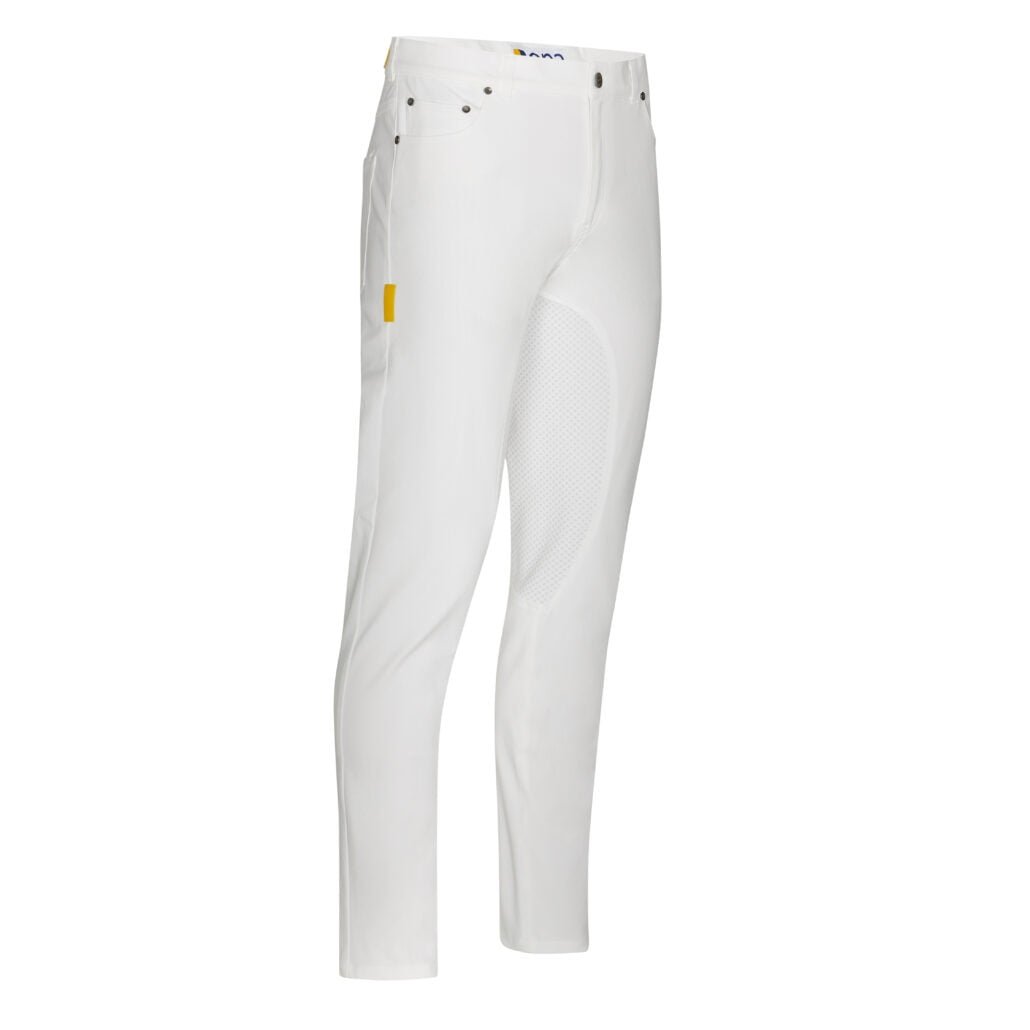
These are the trousers worn for tournaments and official matches, white as required by the dress code. Premium match whites are built from technical stretch fabric with reinforced grip panels at the saddle-contact zone. They are kept for match days and treated with care, because a stain on white is visible from across the field.
Polo breeches
“Breeches” is the traditional equestrian term for close-fitting riding trousers that sit neatly into a tall boot. In polo the terms breeches, britches, and trousers are used loosely and often interchangeably, but the breech proper is the tailored, leg-hugging garment with a finished lower leg designed to disappear under a polo boot.
Practice pants
Practice trousers share the construction of match whites but come in darker colours , typically navy or black , that hide the dirt, grass, and sweat of daily training. Because practice involves constant wear and tear, many practice pants add extra reinforcement in high-friction areas. A serious club player will usually own one or two pairs of whites for matches and several pairs of darker practice trousers for everyday riding.
“The mistake beginners make is buying whites and then schooling in them every day. Whites are your match kit. When we launched our technical polo whites, the first thing high-goal players told us was that they wanted exactly the same engineering in a darker colour , something they could wear in the yard, in practice, every day without worrying about it. That was how Ona’s practice pant was born. Same cut, same grip, same technology, but a colour that forgives the grooming, the falls, and the saddle marks.” , Alejandra Falkinhoff, founder and CEO of Ona Polo
Polo Jeans and Denim
White cotton denim is the classic, more affordable polo trouser, and white “polo jeans” remain common at club level and in arena polo. Denim’s appeal is toughness , the cotton twill is abrasion-resistant and durable , though it lacks the stretch, breathability, and moisture management of a modern technical softshell. Darker denim is also a practical choice for practice and casual chukkas.
Knee-Patch vs. Full-Seat designs and the abductor panel
Borrowed from the wider English-riding world, the grip-placement distinction is worth understanding:
- Knee-patch (half-seat): grip material sits only at the inner knee. This leaves the seat free, giving more mobility – useful for the rising, leaning, standing-in-the-stirrups movement that polo, jumping, and eventing demand.
- Full-seat: grip extends across the seat and down the inner thigh to the knee, giving maximum adhesion and a “locked-in” feel. More common in dressage and useful for less experienced riders who want extra security, but restrictive for the dynamic movement polo requires.
Most polo trousers use a targeted grip panel at the inner thigh and knee, the saddle-contact zone, rather than a full dressage seat, because polo demands the freedom to shift the seat constantly during play.
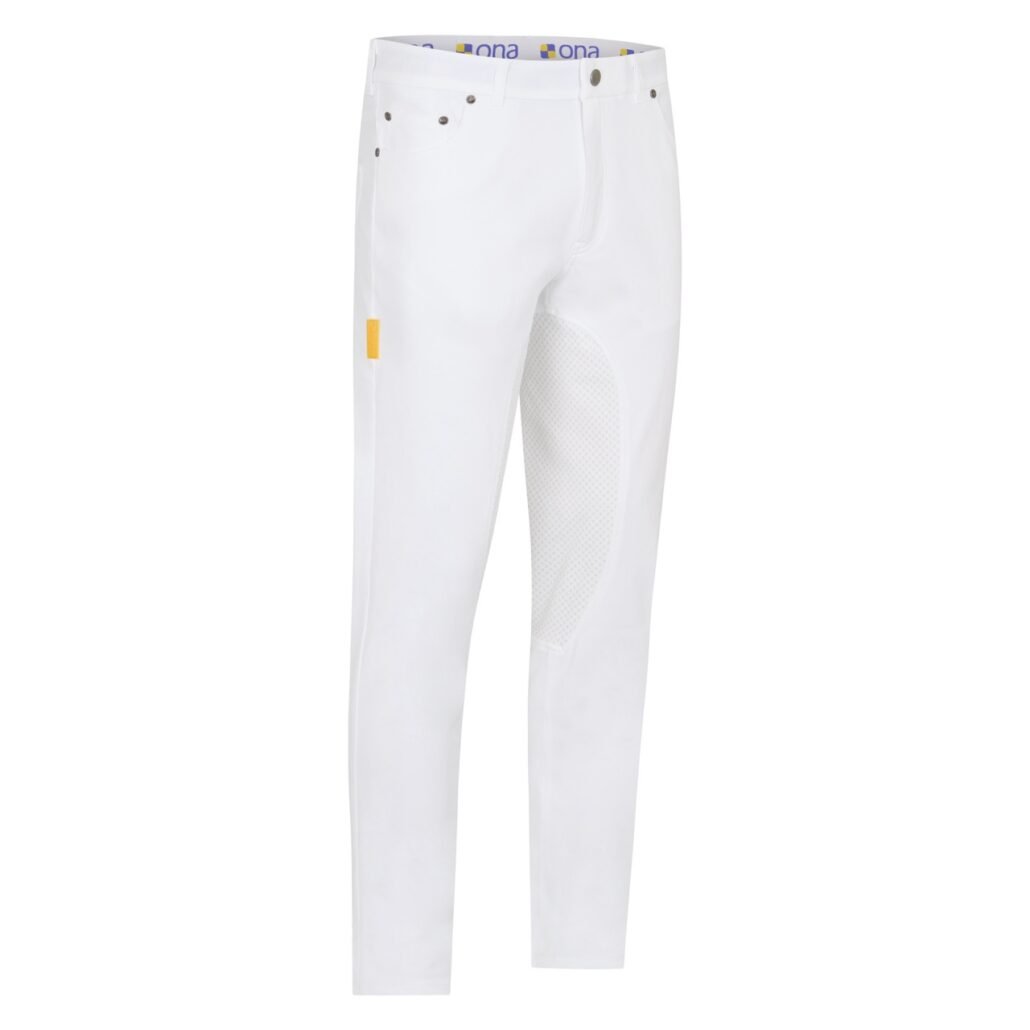
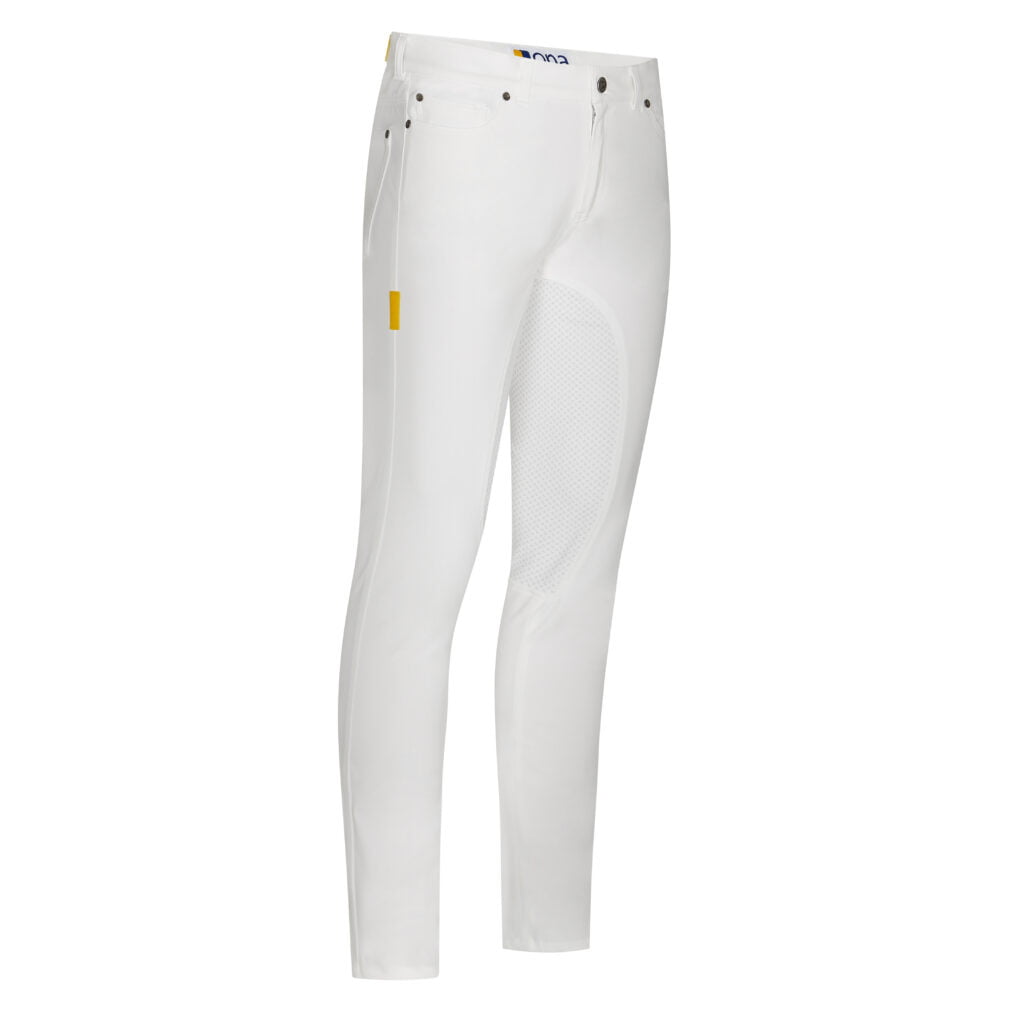
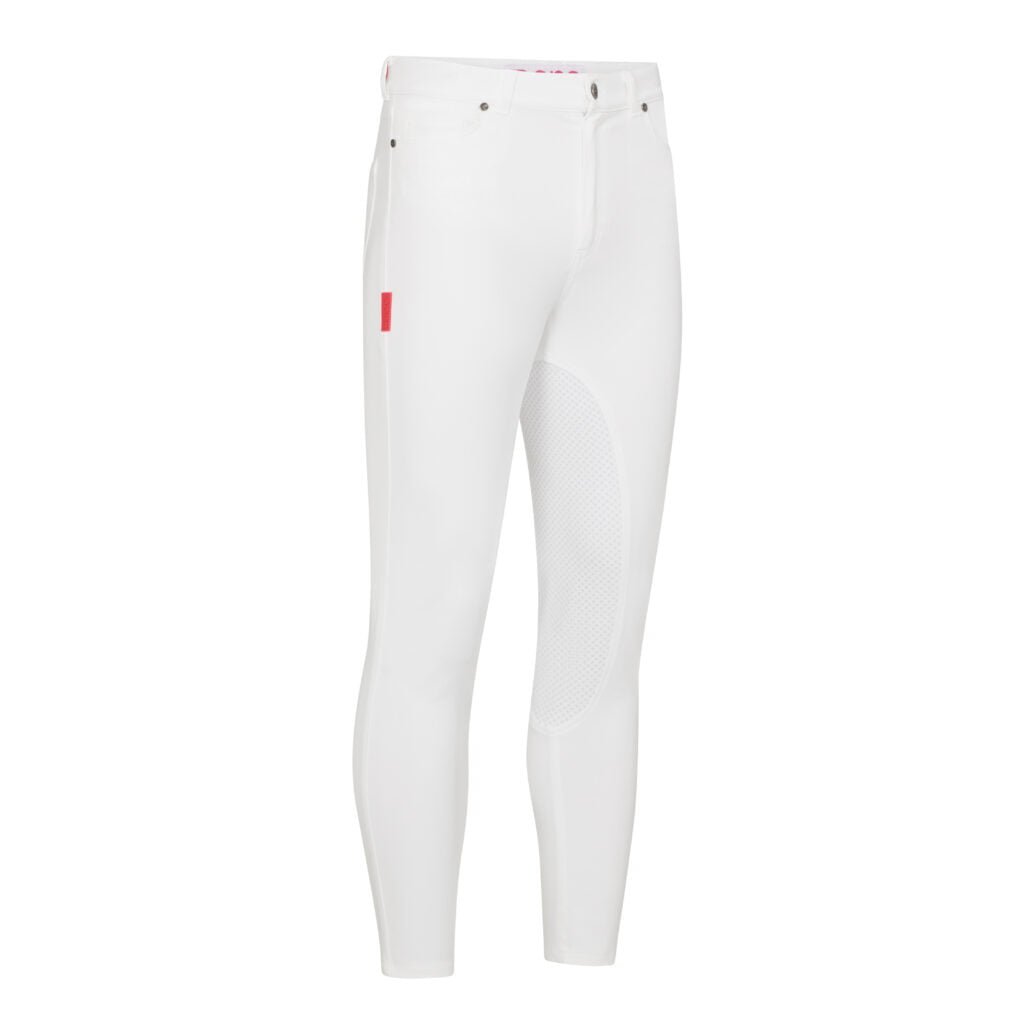
- Abductor panel: (half-seat): grip material extends from below the knee up the inner thigh covering the abductor muscle group – the area doing the most work when a player grips the saddle, leans, or stands in the stirrups. At Ona we use the term abductor panel rather than knee patch, because the panel sits well above the knee and targets the muscles that actually matter in polo. This leaves the seat free, giving mobility for the rising, leaning and standing-in-the-stirrups movement that polo demands.
Waistband and fit variations
Fit is where personal preference rules, and waistband construction varies more than most players realise. A fixed fabric waistband gives a clean, traditional finish. An internal elasticated waistband, the approach Ona takes, sews elastic inside the waistband so it moves with the body without the elastic being visible. And a drawcord waistband, closer to a jogger construction, allows the player to adjust to their exact waistline.
Rise is similarly variable: high, mid, or low (hipster). Low rise, however, is rarely practical in polo , the demands of the swing, the lean, and the gallop mean it can shift and expose the waistline, which is particularly an issue for women. In practice, men tend to prefer a mid rise, while women overwhelmingly favour high rise, which stays in place through the full range of movement the sport demands.
The lower leg tells its own story of evolution. Early polo players wore straight-leg jeans, which left excess fabric that had to be folded and tucked into the sock before the boot could go on, an awkward and time-consuming process. Modern polo trousers have addressed this directly: the leg tapers progressively from the knee downward, finishing with a slim, close-fitting ankle that leaves minimal fabric to manage. The result is a clean, streamlined fit that slides into the boot without bunching, folding, or bulk around the calf.
Polo pant fabrics: What makes a high-performance trouser
The difference between an excellent polo trouser and a mediocre one is mostly fabric. A polo trouser has to do several contradictory things at once: stretch in every direction for an unrestricted swing, resist abrasion against a moving saddle and horse, breathe and wick sweat in summer heat, hold its shape over a long match, and, for whites, stay bright. Here is what to look for.
Four-Way Stretch
The single most important property. Four-way (or bi-elastic) stretch fabric moves with the body in every direction, so the trouser never fights the rider through a full mallet swing, a ride-off, or a sudden change of seat. The best stretch fabrics combine this elasticity with shape retention, so they don’t bag out over a season.
Technical Softshell (Schoeller®)
The benchmark in premium equestrian and polo trousers is Swiss-engineered Schoeller® softshell, a bi-elastic, microfibre-based stretch woven prized for durability, breathability, abrasion resistance, and excellent shape retention. Schoeller Textil AG, founded in Zurich in 1868, launched the world’s first elastic ski-apparel fabric in 1961, essentially the first soft-shell material, and was a founding developer of the bluesign® system. Its equestrian-grade Prestige fabric is specifically engineered for the saddle, offering year-round durability, generous freedom of movement, and an impeccable fit even after a long ride.
Ona was the first polo brand to introduce technical softshell fabric to the sport, securing an exclusivity agreement with Schoeller for the use of their Prestige fabric in polo , a partnership that established a new performance standard for the game and one that no other polo brand has been able to replicate.
“Cotton denim built the tradition, and it still has a place, but a technical softshell is simply a better tool for the modern game. We were the first to bring Schoeller’s Prestige fabric into polo, and the exclusivity we secured means that when players feel that four-way stretch, that breathability through a hot chukka, that fabric that holds its shape and its whiteness far longer , they’re experiencing something no other polo brand can offer. When players feel the difference once, they rarely go back.” , Alejandra Falkinhoff, founder and CEO of Ona Polo
Grip panels
Premium whites integrate a non-slip grip panel at the inner-thigh and knee saddle-contact zone. Ona uses Schoeller® GripIt® , a transparent, durable coating applied to the fabric that improves lateral grip during ride-offs without restricting the rider’s forward-and-back movement in the saddle. The panels are sewn and integrated into the construction of the garment. The majority of other brands have opted for silicone printing in various shapes and sizes to achieve a similar effect , an approach borrowed from other equestrian disciplines such as dressage and show jumping, where silicone grip panels are now near-universal. While silicone printing is a cost-effective and widely used solution, GripIt® offers a more technically refined alternative, functioning as part of the fabric itself rather than a surface application.
Moisture-Wicking and breathability
Polo is a summer sport played at a sprint. A good trouser pulls perspiration away from the skin and lets it evaporate, regulating temperature and keeping the rider comfortable and dry. Technical softshells and microfibre constructions excel here; heavy cotton does not. Quick-drying performance matters beyond the chukka too , players competing regularly need trousers that can be washed and ready again as quickly as possible. Technical fabrics dry significantly faster than cotton, which is particularly important given that most technical polo trousers cannot go in the tumble dryer without compromising the fabric or the grip panels
Abrasion resistance and reinforcement
The inner leg and seat take relentless friction against leather and horse. Abrasion-resistant fabric, flatlock or seamless inner-leg construction, and reinforcement panels in high-wear areas all extend the life of the trouser. Practice pants in particular benefit from doubled reinforcement where daily use wears fastest. Ona is the only polo brand to double the fabric in these critical zones, a decision that significantly extends the life of the garment but also reflects why a truly engineered polo trouser carries a higher price point than an off-the-shelf alternative. It is, in the most literal sense, twice the material where it matters most.
Cotton and cotton blends
Natural cotton denim remains the traditional, breathable, hard-wearing, and accessible option , comfortable against the skin and tough enough for club play. Cotton blends (cotton with elastane or polyester) add stretch and quicker drying while keeping a natural hand. The trade-off versus a technical softshell is less four-way stretch, slower moisture management, and a tendency for white cotton to grey or yellow more readily over time.
Polo pant fabric and care comparison
| Trouser type | Typical fabric | Best for | Stretch & breathability | Approx. price (USD) |
| Match whites (technical) | Schoeller® softshell + grip panel | Tournaments, match play | Excellent (4-way) | $190–$350+ |
| Practice pants | Technical softshell, reinforced | Daily schooling, chukkas | Excellent (4-way) | $190–$350+ |
| White cotton polo jeans | Cotton denim / cotton blend | Club play, arena, beginners | Moderate | $60–$120 |
Prices are indicative ranges for premium polo-specific trousers and vary by brand, market, and specification.
How to care for polo whites and polo pants
White trousers in a sport played on grass, in dirt, around oiled leather tack, is a maintenance challenge by design. The good news: with a consistent routine, premium technical whites should last a full season , and two to three seasons with proper care if you have more than one pair to turn around.
Care goes a long way in extending the life of your whites
The reality of polo is that most stains happen during play , ride-offs, saddle contact, and occasionally blood. These are the occupational hazards of the sport, and knowing how to deal with them promptly makes all the difference.
Washing: The golden rules
- Act fast. Pre-treat stains before they dry and set. Fresh stains lift; old stains fight back.
- Cold water on organic stains. For grass, blood and dirt, cold water prevents the stain from setting , heat fixes it. Pre-treat, then wash.
- Wash whites separately, and only with other whites, to prevent colour transfer and dulling.
- Machine wash at 30°C (86F) on a gentle cycle with a mild detergent. If heavily soiled, soak in warm water with soap before washing.
- Use a detergent for whites with optical brighteners on cotton. Never use fabric softener, which leaves a residue that dulls white and can clog technical fabrics.
Never use bleach on technical fabrics
This is the single most important rule for modern whites. Chlorine bleach degrades elastane and polyamide , the very fibres that give a technical trouser its stretch and grip , and can cause whites to yellow over time rather than brighten. For a gentle brightening boost on appropriate fabrics, a half-cup of white vinegar or a scoop of oxygen-based (not chlorine) brightener is far safer.
Stain removal by type
Grass: Pre-treat with liquid detergent or a stain remover worked gently into the fibres. Always use cold water , heat bonds the chlorophyll pigment to the fabric. Never tumble-dry until the stain is fully gone.
Mud and dirt: Let mud dry completely before treating , working at wet mud spreads it deeper into the fabric. Once dry, brush off the excess, then pre-treat with detergent and wash in cold water.
Blood: Rinse immediately with cold water, never hot, as heat sets blood proteins into the fabric permanently. Soak in cold water with a mild detergent, then wash on a gentle cold cycle. Repeat before drying if the stain persists.
Leather and saddle-oil marks: These are grease-based and won’t dissolve in water alone. Blot away as much as possible without rubbing, then apply an oil-absorbing powder, talcum, cornstarch, or baking soda , and leave it to draw out the grease for several hours or overnight. Brush off, then pre-treat with a small amount of dish soap or a grease-cutting detergent before washing.
Always check the stain is gone before drying, heat sets any remaining mark permanently.
- Grass: Pre-treat with liquid detergent or a stain remover worked gently into the fibres; for stubborn marks, white vinegar is highly effective. Always use cold water and never tumble-dry until the stain is fully gone.
- Dirt and mud: Let mud dry, brush off the excess, then pre-treat and wash. Working at wet mud spreads it.
- Leather and saddle-oil marks: These are grease-based and won’t dissolve in water. Lift as much as possible, then apply an oil-absorbing powder (talcum, cornstarch, or baking soda), leave it to draw out the oil, brush off, and pre-treat with a grease-cutting agent before washing.
- Always check the stain is gone before drying , the heat of a dryer sets any remaining mark permanently.
“The biggest mistake players make is not thinking about care until after the first wash. A technical polo trouser is an investment , treat it right from the start and it will work with you for several seasons. Learn what the fabric needs before you ever put it in the machine, and you will never have to replace a pair before its time.” , Alejandra Falkinhoff, founder and CEO of Ona Polo
Drying, pressing, and storage
- Air-dry whenever possible. Heat is the enemy of technical fibres and elastane. If you must use a dryer, use the lowest setting only. Air drying preserves both fabric and shape.
- Iron with caution. If pressing is preferred, use a low heat setting; high heat can weaken synthetic fibres and scorch white fabric. Steaming is a gentler alternative for removing creases.
- Store clean, dry, cool, and dark. Never store whites dirty, invisible residues oxidise and yellow over time. Avoid sealed plastic, which traps moisture and encourages yellowing; use a breathable cotton garment bag, and keep whites out of direct light in a cool, low-humidity space.
Building a polo wardrobe: Practical recommendations
For a player starting out, the sensible kit is straightforward. Begin with one pair of match whites and one or two pairs of darker practice trousers. Cotton denim whites are a reasonable entry point for club and arena play; invest in a technical softshell pair when you are competing regularly and want the stretch, breathability, and longevity. Choose a gender-specific cut for a comfortable fit and prioritise four-way stretch and a quality inner-leg grip panel, particularly if you are new to the game – you will feel much more secure on the saddle.
Polo trousers are only one part of the player’s kit, and they work alongside other equipment. Polo gloves matter more than newcomers expect: because the game is played right-handed, the left hand holds the reins and the right drives the mallet, so the two gloves do different jobs and good grip is essential for mallet and rein control (a good set of gloves will prevent blisters as well!). A breathable, quick-dry polo shirt or team jersey completes the on-field look. For items outside a specialist apparel range , helmets certified to the current standard, protective eyewear (sports sunglasses that comply to safety standard) knee guards, elbow pads and polo boots , buy from dedicated boot-making specialists, as other riding bootmakers may not be familiar with building a polo boot which is much sturdier and protective than a riding boot.
Polo whites sit at the intersection of heritage and high performance. What began as a practical response to the Indian heat , light clothing, light colour , became a sporting tradition, and that tradition is now carried by garments engineered to a standard the Victorian cavalry could never have imagined. The modern polo trouser stretches four ways, breathes through a chukka, grips the saddle without restricting the seat, resists the relentless abrasion of the game, and, with the right care, stays bright across a full season and beyond.
Understanding the types, the fabrics, and the care turns a confusing purchase into a confident one. Choose the right trouser for the job , technical whites for matches, darker practice pants for daily riding, the correct grip and cut for your seat, treat it well, and it will reward you with comfort, durability, and the quiet elegance that defines the sport.
Frequently asked questions
What are polo whites?
Polo whites are the white trousers, breeches or jeans, that polo players wear for tournaments and matches, required under both HPA, USPA and AAP dress codes. Premium modern whites are made from technical stretch softshell with grip panels at the saddle-contact zone.
Why do polo players wear white trousers?
The tradition traces to 19th-century British India, where players favoured light-coloured, lightweight clothing to cope with the heat. Over time white became the standard for important matches and was formalised into modern tournament dress codes. It is now both a rule and a mark of respect for the sport’s heritage.
What is the difference between polo whites and practice pants?
Whites are for competition and are white as required by the rules. Practice pants share the same construction but come in darker colours (navy or black) that hide daily wear, often with extra reinforcement for the demands of regular training.
What fabric are the best polo pants made from?
The premium standard is technical stretch softshell , such as Swiss-engineered Schoeller® , offering four-way stretch, breathability, abrasion resistance, and shape retention, usually with a grip panel at the inner thigh. Cotton denim is the traditional, more affordable alternative.
How do you keep white polo breeches white?
Wash separately from coloured items, pre-treat stains immediately, use cold water on grass and dirt, wash technical fabrics at 30°C with a mild detergent, never use chlorine bleach on stretch fabric, air-dry out of direct heat, and store clean in a breathable bag away from damp and light.
Can you use bleach on polo whites?
Not on modern technical fabrics. Chlorine bleach degrades the elastane and polyamide that give the trouser its stretch and grip, and can yellow the fabric. Use a mild detergent and, if needed, an oxygen-based brightener or white vinegar instead.
What is the difference between knee-patch and full-seat designs?
Knee-patch grip sits only at the inner knee for maximum mobility; full-seat grip extends across the seat and inner thigh for maximum saddle security. Most polo trousers use a targeted inner-thigh grip panel to balance grip with the freedom polo requires.
Are polo pants and Ralph Lauren “Polo” pants the same thing?
No. The trousers in this guide are competition sportswear for the mounted game , cut for the saddle and built to grip and breathe. Fashion “polo” trousers from lifestyle brands are everyday clothing that borrows the name, not the function.