
Most golfers buy sunglasses to take the edge off the sun. The better question is what a lens does to the things you actually need to see: a white ball against a pale sky, the faint break on a green, the line of a fairway under shifting cloud. Two choices decide most of that. The first is lens colour, which controls contrast. The second is polarisation, which removes glare but also some of the cues golfers use to read the ground.
This guide is built around those two decisions. It explains what each tint does on a golf course and in which light, where polarised lenses help and where they get in the way, and how to match a lens to your course and your tee times. The second half covers the frame, because a lens only works if it stays in front of your eyes when you look down at the ball. At Ona we develop eyewear for polo, a sport played in strong sun where players have to pick out a small white ball against grass and sky at speed, so lens contrast is a question we work on every season. For the technical background on filter categories, light transmission and photochromic lenses, see our companion guide, Lens Tint and Polarisation for Golf. [Internal link: lens guide]
“Golfers often ask us how dark a lens should be. The more useful question is what you need to see. A good golf lens makes the ball easier to find against the sky and keeps the shape of the green readable. A good frame makes sure that lens stays where it should while you look down at the ball.” – Alejandra Falkinhoff, Founder and CEO, Ona Polo
What a Golf Lens has to do
Golf asks unusual things of a sunglass lens. Most of the time you are looking at large areas of green, under light that changes several times over four or five hours. At the key moments you need fine detail: a white ball climbing into a pale or overcast sky, the subtle slope and grain of a green, the edge of a bunker in flat light. A lens that simply makes everything darker can make those details harder to see, not easier.
That is why golfers tend to choose lenses for contrast rather than for darkness alone. In practice the decision comes down to three questions, which the rest of this guide takes in turn:
- Which colour (tint) will give you the most useful contrast on your course?
- How dark should the lens be for the light you usually play in?
- Polarised or not, given that polarisation cuts glare but also removes some of the sheen you read greens with?


Lens colour: What each tint does on a golf course
Colour and darkness are two different choices
A lens tint has two separate properties. Its colour decides which parts of the light spectrum are filtered, and so how colours and contrast look. Its darkness, expressed as a filter category under the European sunglass standard EN ISO 12312-1, decides how much light reaches your eye. A pink lens can be pale or fairly dark; a grey lens can be light or very dark. Choose the colour for contrast, then choose the category for brightness.
| Filter category | Light let through (VLT) | Typical golf use |
| Category 0 | 80–100% | Dawn, dusk, rain; clear lenses |
| Category 1 | 43–80% | Overcast, haze, early tee times |
| Category 2 | 18–43% | Medium or changeable light; the most versatile range for golf in the UK and northern Europe |
| Category 3 | 8–18% | Bright sun, open links and coastal courses, summer rounds |
| Category 4 | 3–8% | Glacier or extreme glare; too dark for golf and not suitable for driving |
For a detailed explanation of light transmission, UV filters and the categories, see the lens guide. [Internal link: lens guide]
Lens colours compared for golf
Retailers and lens makers broadly agree on how the main tints behave on a golf course, although the exact effect depends on the manufacturer’s formula. The table below summarises the consensus.
| Lens colour | What it does on the course | Best light | Watch for |
| Brown, amber, copper | Filters part of the blue light, so the sky darkens relative to a white ball and greens look warmer and more defined. The classic all-round golf tint. | Sun to light cloud; most climates | Changes colour perception more than grey; darker versions can feel heavy in shade |
| Rose, pink, red-based | Boosts contrast and colour intensity; lifts the ball against grass and sky and helps pick out contours on fairways and greens. | Medium, variable and overcast light | Usually lighter (Category 1–2), so less relief on very bright days unless mirrored |
| Grey | Darkens evenly and keeps colours true. Gives the most brightness relief but little extra contrast. | Very bright sun; light-sensitive eyes | Can make greens look flat and a ball harder to separate from a pale sky |
| Grey-green | Similar to grey with slightly more contrast and natural-looking greens. | Bright to sunny | Less contrast than brown or rose |
| Yellow, orange | Brightens the view and sharpens edges in poor light. | Haze, overcast, early morning | Too bright for sun; mostly Category 1 |
| Clear | No tint; protects from wind, debris and UV while keeping full brightness. | Dawn, dusk, rain | No relief from sun |
| Photochromic | Darkens with UV exposure and clears again in shade, so one lens covers a changing day. | Rounds that start early and run into bright light | Reacts to UV, so it may change slowly under tree shade or cloud and barely at all behind a windscreen |
Why contrast tints dominate golf
Two things make brown, amber and rose the default choices on a golf course. First, a white ball against the sky: scattered blue light makes a pale or hazy sky bright, and a tint that filters part of that blue darkens the sky more than the ball, so the ball stands out as it climbs and falls. Second, the ground itself: most of a golf course is green, and tints that shift the balance between green and red make changes in slope, cut and texture easier to see.
Grey works the other way. It reduces everything evenly, which is excellent for comfort in hard sun but adds little contrast. Some golfers love that neutral view; many find a grey lens makes a green look flatter. If you play mostly in bright conditions and want true colours, grey or grey-green makes sense. If you want help finding the ball and reading the ground, start with brown or rose.
Mirror coatings
A mirror is a reflective layer on the front of the lens. It reflects part of the incoming light, so it makes a lens darker and reduces glare, but the colour of the mirror is not the colour you see through: a blue or petrol mirror can sit on a pink or brown base. Judge a mirrored lens by its base tint and its filter category. On a golf course, avoid very dark solid mirrors (black or silver) unless you play in strong sun, as they can make the ball harder to pick up against a pale sky.
Matching the lens to your course and tee time
| Your usual conditions | Where to start | Category |
| Open links, coastal or desert courses, summer sun | Brown or copper; grey-based with a mirror if you prefer true colour | 3 |
| UK and northern European parkland, changeable sky, tree shade | Rose, pink or amber | 2 |
| Overcast, haze, autumn and winter rounds | Rose, amber or yellow | 1–2 |
| First tee at dawn or twilight golf | Clear or a pale contrast tint | 0–1 |
| Long rounds from early morning into midday sun | Photochromic, or a frame with interchangeable lenses | 0–3 |
If you only buy one lens, a Category 2 contrast tint is the safest all-round choice for most golfers in the UK and northern Europe. Players who regularly face hard sun will want a Category 3 option as well, either as a second lens or a second pair.
“For golf we lean on contrast rather than darkness. Our pink, Category 2 lenses were developed to pick out a white ball against grass and sky on a polo field, and that same separation is what a golfer needs on a fairway in medium or changeable light.” – Alejandra Falkinhoff, Founder and CEO, Ona Polo
Polarised golf sunglasses: Do they help or hurt?
What a polarised lens does
Light reflected from a flat surface such as water, wet grass or the face of a bunker becomes partly polarised, mostly in the horizontal plane. That reflected light is what you see as glare. A polarised lens contains a filter that blocks horizontally polarised light, so it removes much of that glare while letting the rest of the scene through. Polarisation is independent of colour: a brown, grey or rose lens can be polarised or not.
Where polarisation helps
- Water and wet surfaces. On courses with lakes, coastal holes or morning dew, polarisation strips glare that otherwise makes you squint.
- Bright sand. Glare from bunkers in strong sun is reduced.
- Eye fatigue. Over four or five hours in bright sun, less glare means less squinting and a more comfortable round.
- Off the course. Driving to the course, fishing or sailing, polarised lenses are hard to beat.
Where polarisation gets in the way
- Reading greens. Golfers read grain and moisture partly from sheen: grass growing away from you tends to look shiny, grass growing towards you looks darker. A polarised lens removes much of that sheen, so the green can look flatter and the grain harder to read. Some players simply lift their sunglasses to read the putt.
- Depth perception. Some golfers report that polarised lenses make slopes and distances feel different. The evidence is thin either way, and plenty of golfers notice nothing, but it is a common reason players switch back.
- Screens. LCD screens and many phone displays emit polarised light. Viewed through a polarised lens at certain angles, a GPS unit, buggy screen, phone or some rangefinder displays can darken, black out or show rainbow patterns.
Polarised versus high-contrast non-polarised: side by side
| Polarised lens | High-contrast non-polarised lens | |
| Glare from water, sand and wet grass | Strongly reduced | Reduced only by tint and any mirror |
| Reading greens (sheen and grain) | Sheen largely removed; greens can look flatter | Sheen visible; contrast tint helps define contours |
| Ball against the sky | Good, especially with a brown or copper base | Good with brown, amber or rose |
| GPS, buggy and phone screens | May darken at some angles | Unaffected |
| Comfort in hard sun | Excellent | Good, depending on category and mirror |
| Best fit for | Bright, watery or coastal courses; glare-sensitive eyes | Players who prioritise green reading; changeable light |
So should golf sunglasses be polarised?
There is no single answer, which is why many golf-specific lenses from major brands are deliberately non-polarised, while others sell polarised golf models in volume. A practical way to decide:
- Choose polarised if you play in hard sun, on courses with a lot of water, or suffer from glare, and you are happy to lift your glasses when you read a putt.
- Choose a high-contrast non-polarised lens if green reading is your priority, you rely on a GPS watch or rangefinder screen, or you mostly play in medium and changeable light.
- If you can, test both on the same course, in the same light, and judge the greens rather than the view from the tee.
How to tell if a lens is polarised: look at a phone or computer screen through the lens and tilt your head slowly to the side. If the screen darkens sharply at around 60–90 degrees, the lens is polarised.
“We would never tell a golfer that one lens suits every course. If you play by the sea in hard summer sun, cutting glare can make a long day much easier on the eyes. If your game lives on the greens, try a high-contrast lens and see whether the slopes look clearer. Test both before you decide.” – Alejandra Falkinhoff, Founder and CEO, Ona Polo
Fit: Keeping the lens where it should be
The best lens in the world does nothing if the frame slides down your nose as you settle over a putt. Golf is hard on fit: your head is down at the key moments, you sweat over a long walk, and a cap presses on the temples.
Reading the three-number size code
Most sun frames carry a size code inside a temple arm, such as 55-17-140: lens width, bridge width and temple length in millimetres. A quick check when buying online: overall frame width ≈ (2 × lens width) + bridge width, plus a few millimetres for the frame. Compare it with a pair that already fits you well. As a rough guide, retailer size charts put “small” frames at around 49–54 mm lens width with 130–135 mm temples, “medium” at 55–58 mm with 135–140 mm, and “large” at 59–63 mm with 140–145 mm. Sizing is not standardised between brands, so treat these as ranges.
| Face profile | Where to start | What to watch for |
| Small faces (including many women and juniors) | Smaller lens width, shorter temples, narrower bridge | Frame edges past the temples; wrap touching the cheeks |
| Large faces or big heads | Larger lens width, longer and flexible temples | Temples pressing on the side of the head |
| Low nose bridge / high cheekbones | Taller or adjustable nose pads; narrower bridge; less lens tilt | Frame resting on the cheeks, lifting when you smile, fogging |
What good fit feels like
Sports opticians describe a well-fitted frame as having three-point contact: the bridge of the nose and behind each ear, and nothing else. Your eyes should sit centred in the lenses, the frame should stay clear of your cheeks when you smile or squint, and the temples should lie flat along the side of your head and grip lightly behind the ear.
Golf glasses that don’t slip
Sweat lowers friction at the nose and temples just as your head tilts forward for a putt, and gravity does the rest. To prevent it:
- Choose rubberised grips at both the nose and the temple tips. Soft hydrophilic rubbers such as Megol tend to hold better as they get damp.
- Use adjustable nose pads or temples that can be shaped to your face. Low-bridge (sometimes called “alternative” or “Asian”) fit is a fit category, not an ethnic one, and suits anyone with a flatter bridge or high cheekbones.
- Do not fix a loose frame by over-tightening it; a frame that clamps will cause a headache before the back nine.
- Check fit in your golf posture and under your usual cap or visor: slim, fairly straight temples slide under the band without tilting the frame.
“On a polo pony, eyewear that moves is eyewear that fails, so we design around a soft Megol nosepad and adjustable Megol temple tips that let each player fine-tune the hold. Golf is gentler, but the principle is the same: the frame should stay where you put it, through heat, sweat and a head-down posture, without clamping.” – Alejandra Falkinhoff, Founder and CEO, Ona Polo
Coverage and your view at address
Wrap, base curve and side light
Base curve describes how strongly the lens is curved. Base 4 and below is nearly flat; Base 6 is a moderate wrap with good side coverage and a more open feel; Base 8 follows the face closely. More wrap blocks side light and wind and keeps stray glare from entering around the frame, which matters as much for comfort as the lens itself. A lens can block 100% of UV and still let light in at the sides, which is why the WHO advises wraparound or close-fitting designs.
Wrapping a lens around the face can introduce slight optical distortion. Manufacturers correct it by decentring the lens; if a lens is described as optically correct or decentred, the maker is claiming to have done so. On a golf course this matters because an uncorrected lens can make the ball or the line of a putt appear very slightly displaced.
Seeing the ball at address
At address and over a putt your eyes rotate down towards the bottom of the frame. With a shallow lens or a heavy lower rim, you end up looking under the lens or across the rim, and the tint you chose so carefully is no longer in front of your eye. Look for a deep lens, a semi-rimless design with no lower rim, or a frame with a removable lower bumper. When you turn your head towards the target, a heavy brow bar should not cut into your view of the flag.
Comfort and anti-fog
- Light, flexible frames such as Grilamid TR90 follow the head instead of clamping, which you will notice by the 14th hole more than the number on the scales.
- A small gap between frame and face lets air move; frames that rest on the cheeks trap warm air and fog.
- Hydrophobic and oleophobic coatings make sweat, rain and skin oils bead and wipe away, which keeps the lens clear between shots.
Prescription golf sunglasses
Golfers who need vision correction have four broad options:
| Option | Strengths | Limitations |
| Direct-glazed prescription in a wrap frame | Widest field of view, light, less fogging, one clean lens | Limited range in high-wrap frames; more expensive |
| Clip-in Rx insert behind a plano lens | Handles strong prescriptions; only the insert changes | Narrower view, more fogging, double-lens effect |
| Contact lenses under plano sunglasses | Full field of view, any frame and any tint | Dryness in wind and sun; not for everyone |
| Fit-over sunglasses | Cheap and simple | Bulky and prone to fogging |
The higher the base curve, the harder it is to make a strong prescription accurate across the whole lens; beyond roughly −4.00 to +3.00 total power, talk to a specialist. Progressive wearers often have to tilt their head further to see the ball at address; some golf opticians suggest single-vision distance lenses for play. Ask your supplier which tints and contrast options are available in your prescription before you settle on a frame.
Durability and care
- Rinse before you wipe. Sand and grit act like sandpaper on lens coatings; rinse with clean water, then dry with a microfibre cloth.
- Avoid household cleaners, paper towels and your shirt hem.
- Never leave eyewear in a hot car; heat can distort frames and damage coatings and mirrors.
- Store the pair in a hard case, never lens-down and never loose in the golf bag.
- Look for replaceable lenses and grips, so a scratched lens or worn nose pad does not mean a new frame.
A note on impact protection. Serious golf eye injuries are rare, and most golfers do not need safety-rated eyewear to play. If you want extra reassurance, for juniors, busy driving ranges or courses with crossing fairways, choose a polycarbonate or Trivex lens rather than glass, and look for a recognised impact marking on the frame.
The golf sunglasses buyer’s checklist and try-on test
Buyer’s checklist
| Criterion | Why it matters |
| A contrast tint (brown, amber or rose) unless you specifically want true colour | Helps you find the ball and read the ground |
| Filter category matched to your usual light (Category 2 is the all-round choice) | Enough relief without losing the ball in shade |
| A deliberate polarisation decision | Less glare versus easier green reading and readable screens |
| Mirror judged by its base tint, not its colour | The mirror colour is not what you see |
| Interchangeable or photochromic lens if your light changes a lot | One frame for the whole day |
| Lens described as optically correct or decentred | No distortion of the ball or the green |
| Three-point contact, rubberised grips, temples that work under your cap | The lens stays in front of your eyes |
| Deep lens, or no lower rim at address | You look through the tint, not under it |
| Polycarbonate or Trivex lens; spare lenses and a hard case | Durability and long service life |
The five-minute try-on test
- The light test (outdoors). Look at grass, a pale sky and a white object. The white should stand out clearly from the sky, and the grass should look defined rather than flat.
- The polarisation test. Look at your phone or GPS screen through the lens and tilt your head. If the screen darkens, the lens is polarised; decide whether you can live with that.
- The shade test. Step from sun into shade. If the view becomes murky, the lens is too dark for your course.
- The address test. Take your address posture over a ball or a coin for 30 seconds. You should see it through the lens, not under it, and the frame should not move.
- The cap and shake test. Put on your usual cap, make a few half-swings and nod firmly. The frame should neither tilt nor slide.
If you buy online, check the returns policy before removing protective films, so you can do this test on a pair you can still return.
How Ona eyewear meets these criteria
Ona’s eyewear was developed for polo, a sport played in strong sun where players have to pick out a white ball against grass and sky. Several Ona models are also listed in our golf sunglasses collection. Here is how the range compares with the criteria in this guide, using only the specifications published on our product pages.
ONA® VCP21
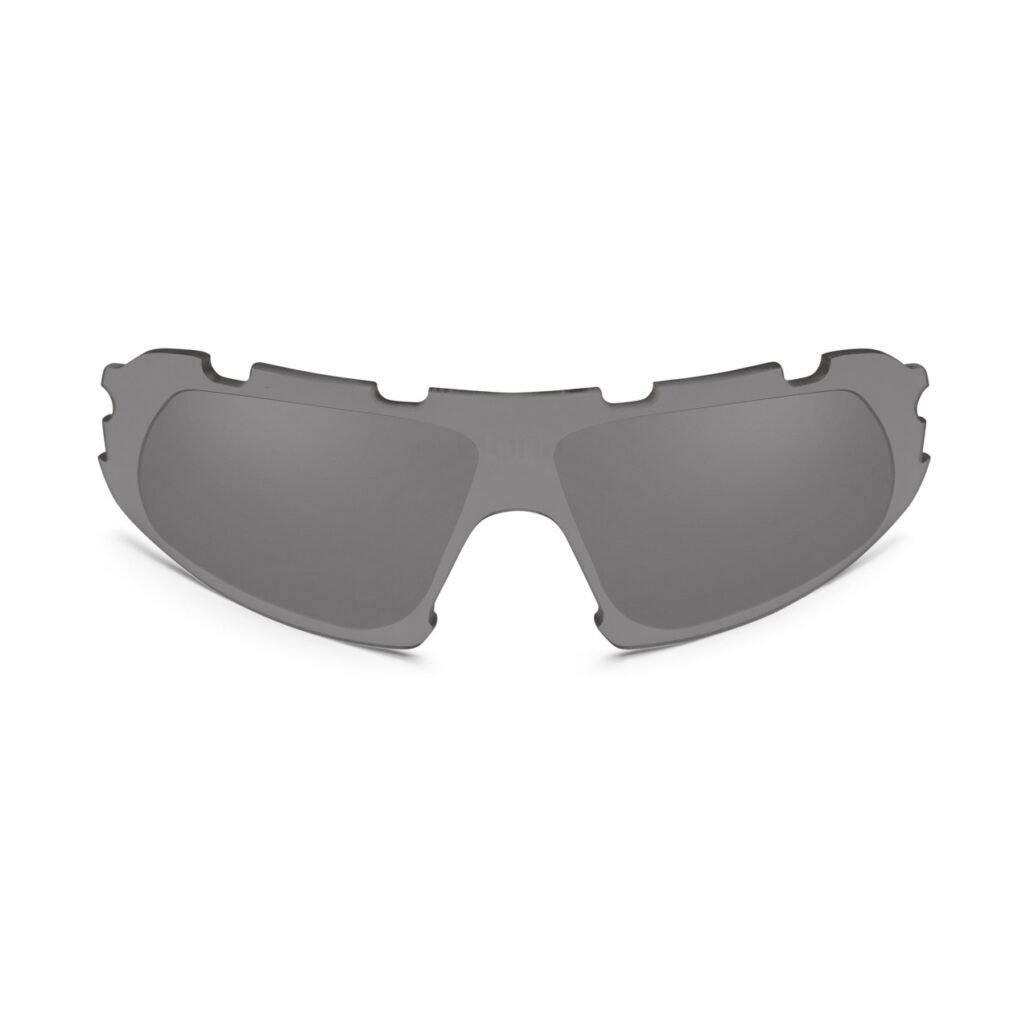
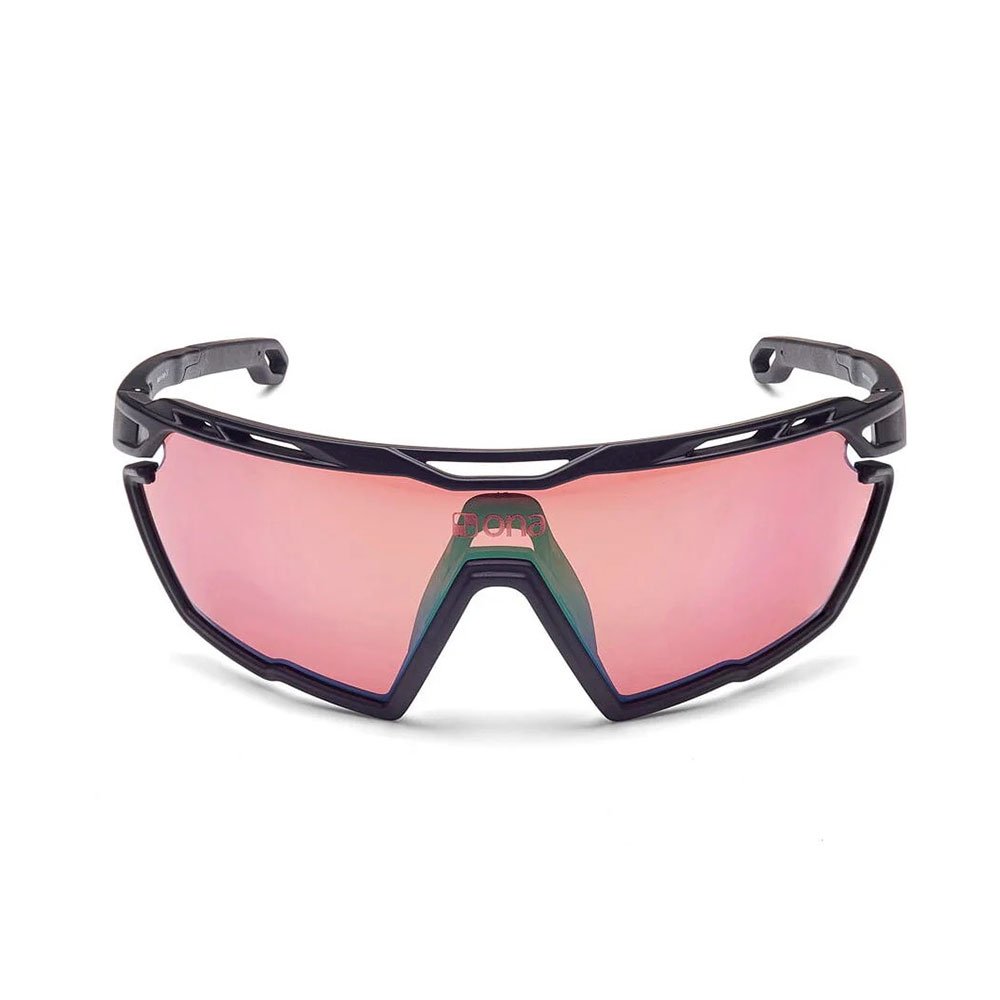
- Lenses: supplied with two interchangeable lenses: a pink lens with a petrol mirror (filter Category 2, medium light, increased contrast) and a clear lens (Category 0, low light). That covers bright-but-changeable days and early or late rounds with one frame. Both lenses offer 100% UV protection and hydrophobic and oleophobic treatment on both sides.
- Fit: a lightweight, flexible Grilamid frame, a soft Megol nosepad and adjustable Megol temple tips.
- Coverage: an optically correct curved lens, with an interchangeable bumper (lower bar) and nosepiece so you can choose an open lower edge for a clear view at address.
- Durability: the most robust frame in the range, tested beyond civilian standards.
AELOX PK
- Lens: a fixed high-contrast pink lens, filter Category 2, designed for medium, overcast and variable light: the conditions most UK and northern European rounds are played in.
- Fit and coverage: a Base 6 shield (a moderate wrap with a more open feel than the VCP21), a Grilamid TR90 frame and Megol grips at the nose and temples.
AELOX PH
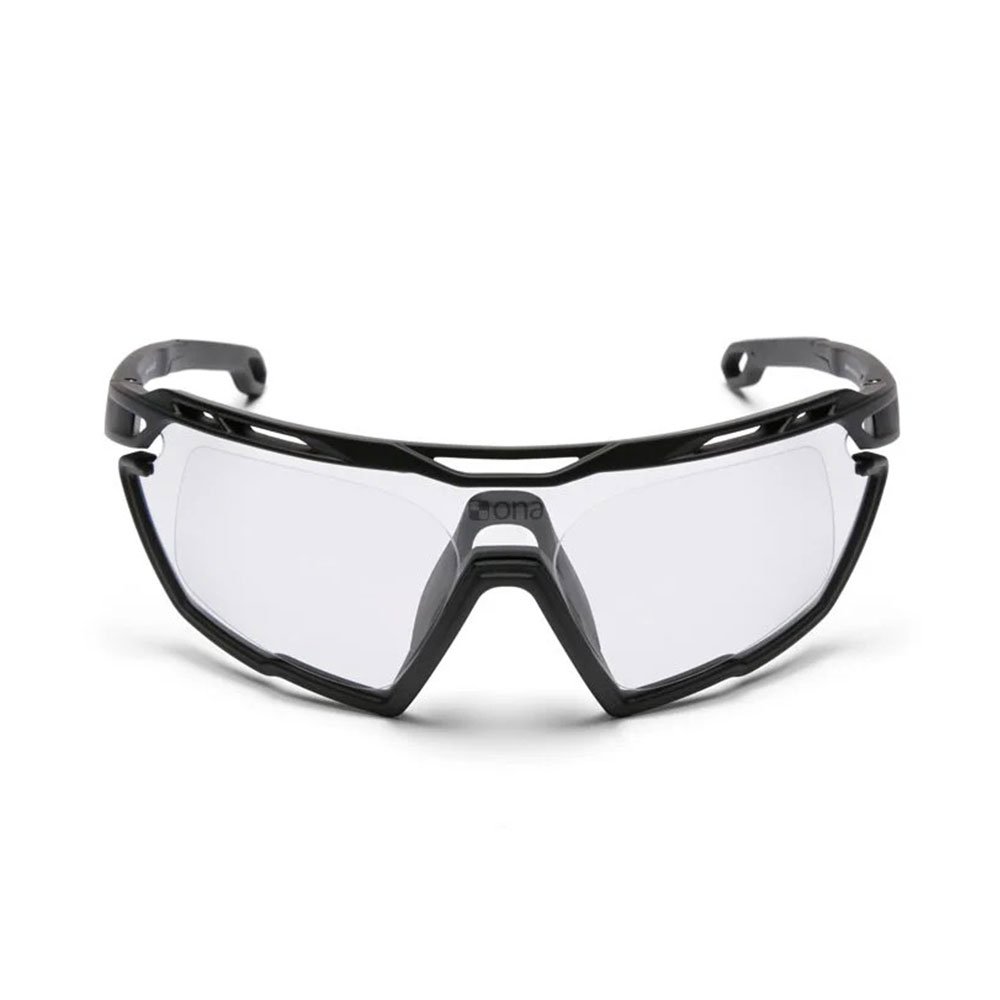
- The same Base 6 AELOX frame with a photochromic lens that moves from clear (Category 0) to dark grey (Category 3), for rounds that start early and finish in bright sun. Supplied with a hard zip-up case and microfibre pouch.
Prescription: VCP21 RX and AELOX RX
- VCP21 RX and AELOX RX build the prescription into a one-piece curved lens rather than an insert, in single vision or progressive. Given the wrap-frame prescription limits described above, contact Ona with your prescription before ordering.
If your light changes through the day and you want one frame for everything, the VCP21 with its two lenses is the most versatile. If you mostly play in medium or overcast light and like a more open fit, the AELOX PK’s high-contrast pink lens is the specialist choice. If your rounds run from early morning into midday sun, the AELOX PH adapts as the light does.
From the polo field to the fairway
Polo players and golfers share more than you might think: long days in strong sun, a small white ball to track against grass and sky, and a sport where reading the ground affects every decision. Polo adds speed and a gallop, which is why Ona designs for contrast, a secure fit and grip first. For the polo-specific view, see our polo eyewear guide. Golfers who play or watch polo in summer can use the same pair: a high-contrast lens that works at the club in the morning and by the pitch in the afternoon.
Choosing golf sunglasses starts with the lens. Pick a colour for contrast, usually brown, amber or rose, and a filter category for the light you play in, with Category 2 as the safe all-round choice. Then make a deliberate decision on polarisation: it is excellent against glare on bright and watery courses, but it can flatten the greens and darken your screens, which is why many golfers prefer a high-contrast non-polarised lens. Finally, make sure the frame keeps that lens in front of your eyes: three-point contact, grip that holds when you sweat, and a view of the ball at address that is not cut by the rim.
“The best compliment a golfer can pay a pair of sunglasses is that the ball looked clearer, the greens made more sense, and they forgot they were wearing them.” – Alejandra Falkinhoff, Founder and CEO, Ona Polo
Frequently asked questions
What lens colour is best for golf?
For most golfers, a brown, amber or rose contrast tint. These filter part of the blue light, so a white ball stands out against the sky and greens look more defined. Grey keeps colours true and gives the most relief in hard sun, but adds little contrast.
Are polarised sunglasses good for golf?
They are good at cutting glare from water, sand and wet grass, which helps on bright or coastal courses. The trade-off is that they remove some of the sheen golfers use to read grain on the greens, and they can darken GPS and phone screens. Many golfers prefer a high-contrast non-polarised lens for that reason.
Can you read greens with polarised sunglasses?
You can, but it is harder for many players. Polarisation removes much of the sheen that shows grain direction and moisture, so the green can look flatter. Some golfers lift their sunglasses to read a putt.
Do polarised sunglasses affect GPS and rangefinder screens?
They can. LCD screens and many phone displays emit polarised light, so through a polarised lens they may darken or show rainbow patterns at certain angles. Check your own devices before you buy.
Are pink or rose lenses good for golf?
Yes. Rose and pink tints boost contrast and colour intensity, helping to lift the ball against grass and sky and to pick out contours. They suit medium, variable and overcast light; in very bright sun you may want a darker or mirrored version.
What lens is best for golf on cloudy days?
A lighter contrast tint, such as rose, amber or yellow, in filter Category 1 or 2. A dark grey lens on an overcast day makes the course look flat and the ball harder to follow.
What filter category do I need for golf?
Category 2 is the most versatile choice for golfers in the UK and northern Europe. Category 3 suits bright summer sun and open courses. Category 4 is too dark for golf.
Are mirrored lenses good for golf?
A mirror reduces brightness and glare, but the colour you see comes from the base tint, not the mirror. Avoid very dark solid mirrors unless you play in strong sun.
Are photochromic lenses good for golf?
They suit rounds that start early and run into bright sun, because one lens adapts as the light changes. They react to UV, so they can change slowly under cloud or tree shade.
How should golf sunglasses fit?
They should touch only the bridge of your nose and behind each ear, with your eyes centred in the lenses and no contact with your cheeks. Test them in your address posture: the frame should not slide, and you should see the ball through the lens, not under it.
How do I stop my sunglasses slipping when I sweat?
Choose rubberised nose pads and temple tips, adjust the temples to hold behind your ears, and make sure the frame is not resting on your cheeks. Avoid frames that only stay on by clamping.
Rimless or full-rim golf sunglasses?
Rimless and semi-rimless designs clear your view of the ball at address, while full rims hold the lens more securely. A frame with a removable lower bumper lets you choose.
Can I get prescription golf sunglasses in a wraparound frame?
Often, yes. Strong prescriptions are harder in high-wrap frames; beyond roughly −4.00 to +3.00 total power, consult a specialist. Ona’s VCP21 RX and AELOX RX build the prescription into a one-piece curved lens.
What are the best golf sunglasses for small faces?
Look for a smaller lens width and shorter temples (around 49–54 mm lens width and 130–135 mm temples on typical size charts), a narrower bridge, and a wrap that does not touch your cheeks.