
There is a moment, familiar to every polo player who has ridden through a British winter, that no amount of talent prepares you for. The chukka ends. You come off a pony that has just carried you through seven minutes of sprints, turns and full-swing effort, and you are soaked through. Then you stand still. Within ninety seconds the wind finds the damp fabric against your spine and the warmth drains out of you faster than it went in. By the time you are legged up on the next pony, your hands are stiff and your shoulders have tightened.
That cycle, violent exertion, abrupt stillness, repeat, is what makes polo unusually demanding on the layer worn closest to the skin. It is not an endurance sport, and it is not a steady-state one. It is a series of intervals separated by breaks just long enough to get cold in. Most base layer advice written for riders assumes a hack or a schooling session: sustained, moderate output at a predictable temperature. Polo is not that.
Merino wool has become the default answer to this problem across mountaineering, trail running and military cold-weather kit, and it has moved steadily into equestrian wardrobes over the past decade. This guide explains why – properly, with the underlying fibre science rather than the marketing shorthand, and then turns to the decisions that actually matter when you buy: how to read fibre diameter and fabric weight, how to judge a fit in the saddle rather than in front of a mirror, how to build a layering system for a match day, and how to wash the garment so it survives more than one season.
“Players notice their gloves and their boots. Almost nobody thinks about the layer against their skin until the moment they are standing in the cold between chukkas, wondering why they cannot get warm again. It is the least visible thing they own and the first thing that decides whether the afternoon is enjoyable.” – Alejandra Falkinhoff, CEO, Ona Polo
Why the Base Layer matters more in Polo than in most riding
A base layer has one job: manage moisture at the skin. Everything else, warmth, comfort, odour, freedom of movement, follows from how well it does that. In disciplines with steady output, a moderate garment gets away with a great deal. Polo exposes the weaknesses.
The chukka problem: sweat spikes and rapid cooling
During a chukka your body produces heat and sweat far faster than the surrounding air can carry it away. Then you stop, change ponies, and stand in the cold with that moisture still in your clothing. Evaporative cooling, which was helping you a minute ago, now works against you, the same physics, the wrong direction.
This is precisely where the two main base layer technologies diverge. Synthetic fabrics move sweat along the outside of the fibres by capillary action; the moisture sits on the surface of the fabric, where it evaporates quickly and cools you quickly. Merino does something different, which the next section explains, and the practical result is a garment that buffers the spike instead of amplifying the crash.
Range of motion and the polo swing
The second, less-discussed demand is mechanical. A full offside forehand takes the shoulder through a range that few other sports ask for on horseback, and it does so repeatedly, under a shirt, often over elbow protection. A base layer that binds at the shoulder or rides up at the waist is not a minor irritation, it changes how freely you swing.
This is why cut, seam placement and stretch matter as much as fibre content on a polo base layer, and why a garment designed for static warmth – a thermal vest, a cotton long-sleeve – is the wrong tool even when the temperature suggests otherwise.
How Merino wool actually works
Merino’s reputation rests on three properties that are frequently repeated and rarely explained. Understanding them is what allows you to judge whether a given garment is worth its price.
“What convinced me was not the warmth. I was walking off the field after training and finding that the shirt underneath still felt dry. You spend years accepting that being wet through is simply part of playing in winter, and then one day it is not. That is the point at which you stop thinking of a base layer as an accessory and start thinking of it as equipment.” – Alejandra Falkinhoff, CEO, Ona Polo
Hygroscopic, not simply wicking
Merino is hygroscopic: it absorbs water vapour into the interior of the fibre, the cortex, rather than carrying it along the surface. The outer cuticle is covered in overlapping waxy scales that shed liquid water, while vapour passes between them and is held inside.
The consequence is a large moisture buffer. Merino can absorb in the region of a third of its dry weight in moisture vapour before it feels wet to the touch. Most synthetics feel damp once they hold well under a tenth of theirs, because the water is sitting on the outside of the fibre where your skin can feel it. That difference is the whole argument, and it is why merino tends not to go clammy in the interval between chukkas.
Heat of sorption: the fibre that warms as you cool
When wool absorbs moisture vapour it releases a small amount of heat, an effect documented as far back as the mid-nineteenth century and known as the heat of sorption. It is modest, and no base layer will substitute for a coat. But its timing is remarkable: the effect is strongest exactly when you have stopped moving and your damp clothing is beginning to cool. For a sport built around intervals, that is the right effect at the right moment.
Odour resistance
Merino absorbs and traps the volatile compounds responsible for body odour, and its surface chemistry is less hospitable to odour-forming bacteria than smooth synthetic filament. The honest claim is resistance, not sterility – merino gets dirty like anything else. The practical benefit is that a merino base layer can be worn across a weekend of stick-and-ball, or packed for a tournament, without needing a wash between every wear.
It is worth noting that this is a property of the fibre itself rather than an applied finish. Synthetic base layers achieve something similar with an antimicrobial treatment, which works well when new and gradually washes out. Riders who travel to matches tend to rate this difference more highly than the thermal performance.
Thermoregulation in both directions
The natural crimp of merino fibre traps still air, which is what insulates you in the cold. In warmer conditions the same moisture cycle running in reverse, vapour desorbing and evaporating, draws heat away from the skin. This is why a single lightweight merino garment can be genuinely useful across a spring practice session and a January arena match, rather than only one of the two.
Reading the spec sheet: Fibre diameter and fabric weight
Two numbers tell you most of what you need to know about a merino garment before you have touched it. Neither is difficult to interpret once you know what they describe.
Micron: fibre diameter and the prickle threshold
Micron (µm) measures the average diameter of the fibre, and it is the single best predictor of next-to-skin comfort. The reason is mechanical: a fibre’s stiffness rises roughly with the fourth power of its diameter, so a small increase in thickness makes a fibre dramatically less willing to bend. Coarse fibre ends do not fold away against the skin, they press into it, triggering the nerve response we call prickle. Textile research places that threshold at around 30 µm at the individual fibre end; in practice, a fabric averaging under about 22 µm reads as comfortable, and finer is better still.
This is the difference between the wool that made a previous generation distrust the material entirely and the wool used in modern performance garments. It is the same fibre; it is not the same grade. If you have ever been told you cannot wear wool against your skin, there is a reasonable chance you have simply never worn fine merino.
Micron grades and what they mean next to the skin
| Grade | Micron range | Next-to-skin verdict |
| Ultrafine | Below 17.5 µm | Exceptionally soft; the premium tier, and priced accordingly |
| Superfine | 17.5 – 19.5 µm | The performance sweet spot for riding – soft, durable, sensibly priced |
| Fine | 19.6 – 21.5 µm | Comfortable for most wearers; some sensitivity possible |
| Above 22 µm | 22 µm and coarser | Better suited to mid-layers and outerwear than to skin contact |
Fabric weight: what 160g actually means on a horse
Fabric weight, quoted in grams per square metre, describes how much fabric there is and therefore how warm the garment runs on its own. It is the number most often ignored by buyers and most responsible for disappointment.
The common error is to assume heavier is better for winter. It is not, it is better for standing still. A heavyweight base layer worn during a chukka will have you overheating within minutes, and once it is saturated it becomes a liability for the rest of the afternoon. For active riding the correct approach is a lighter next-to-skin layer that moves moisture efficiently, with insulation added and removed as a separate mid-layer.
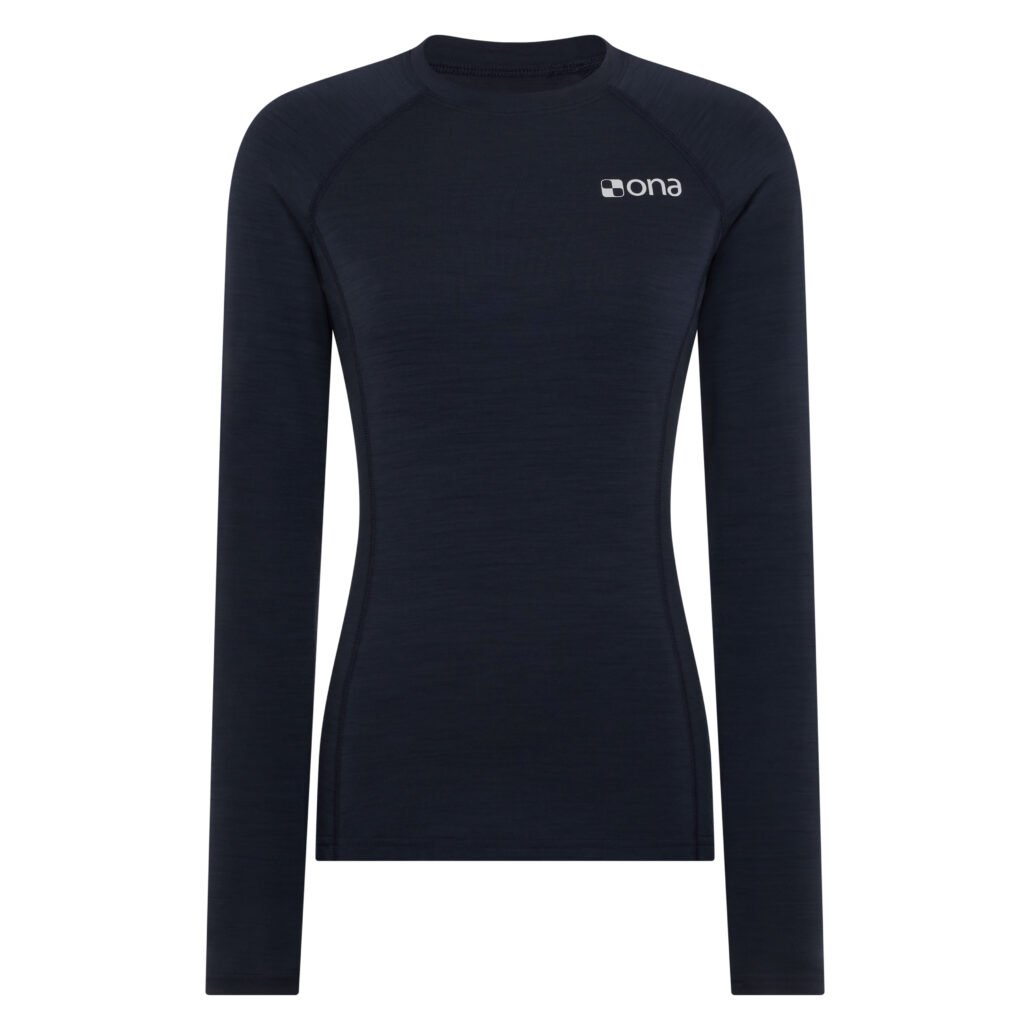
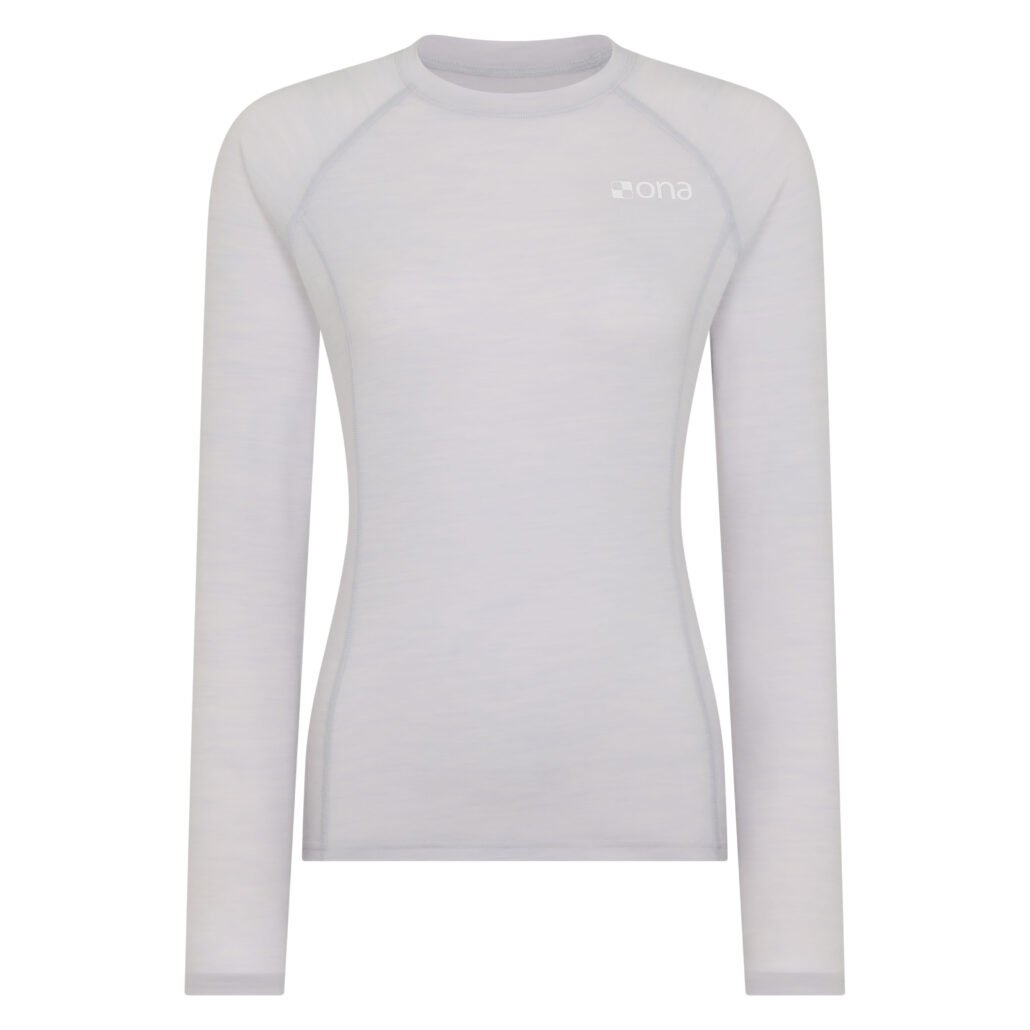
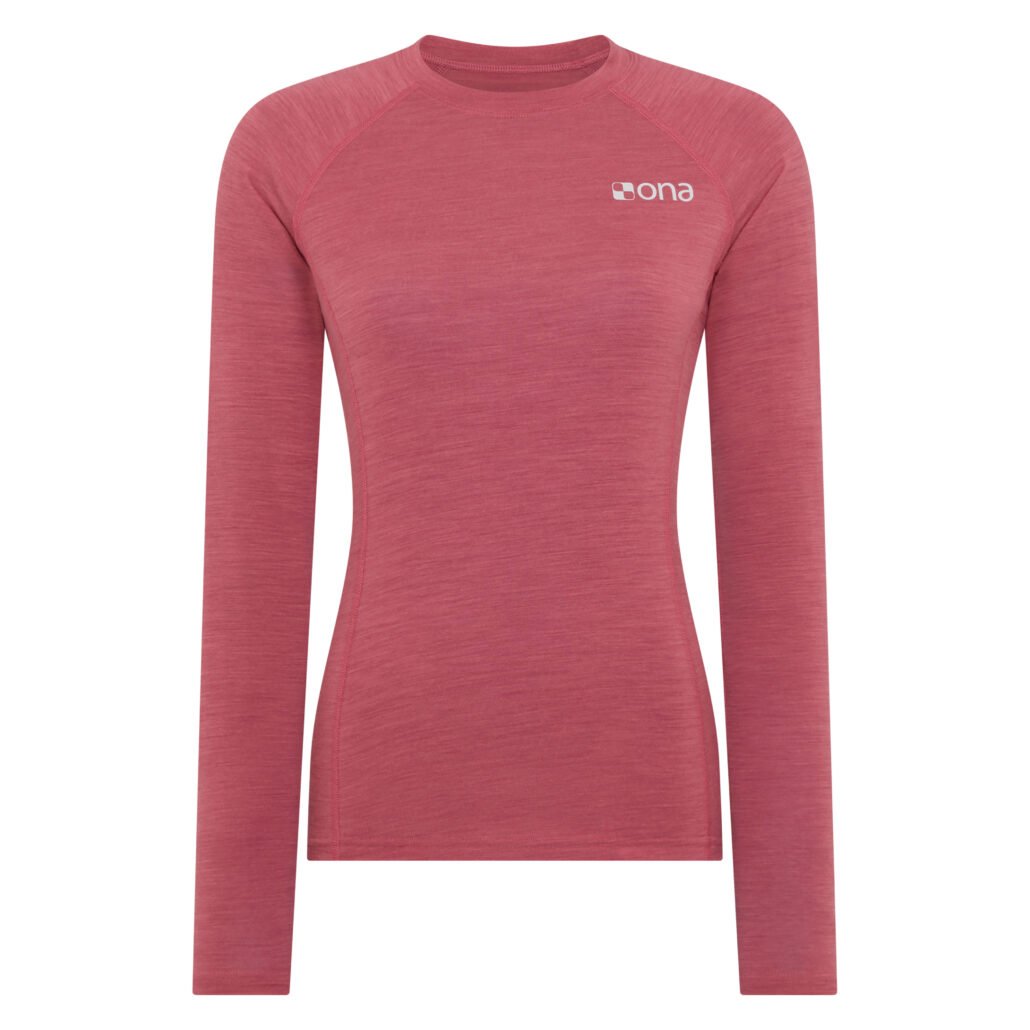
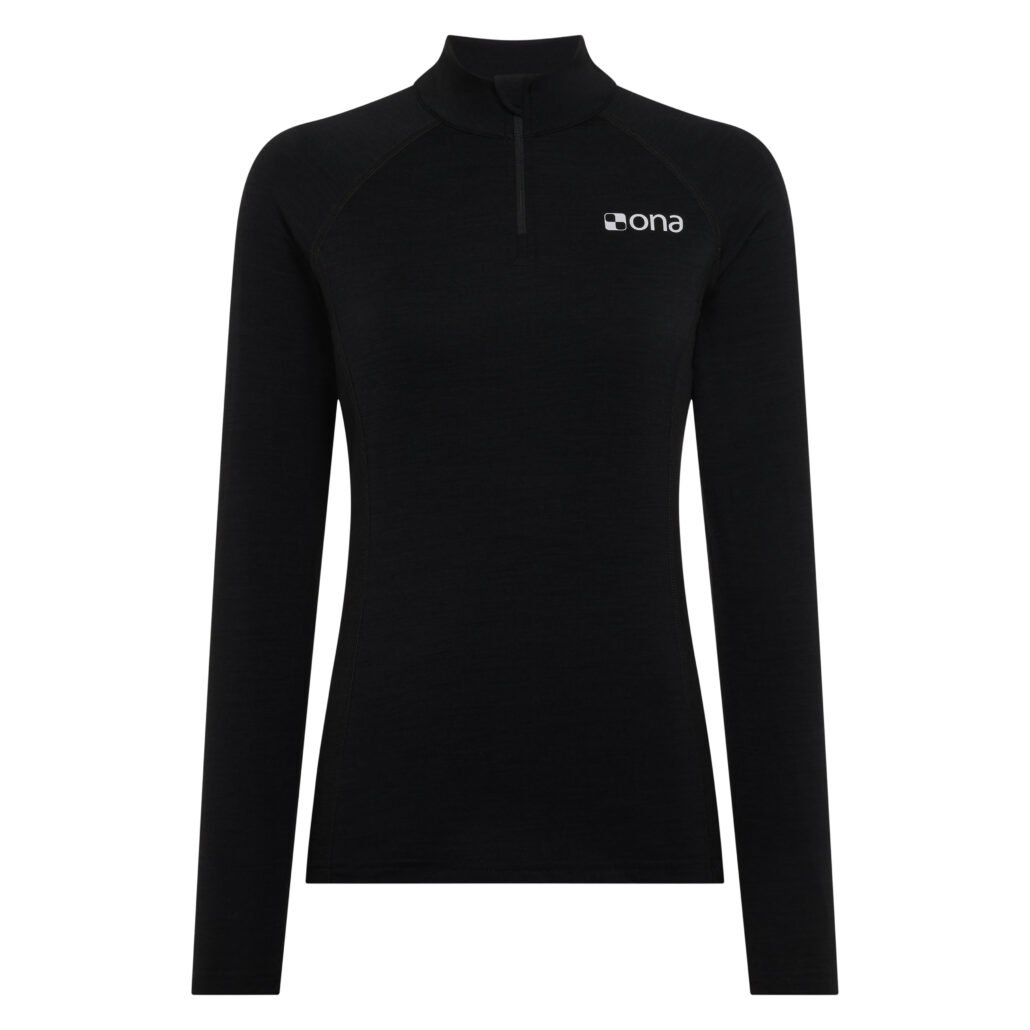
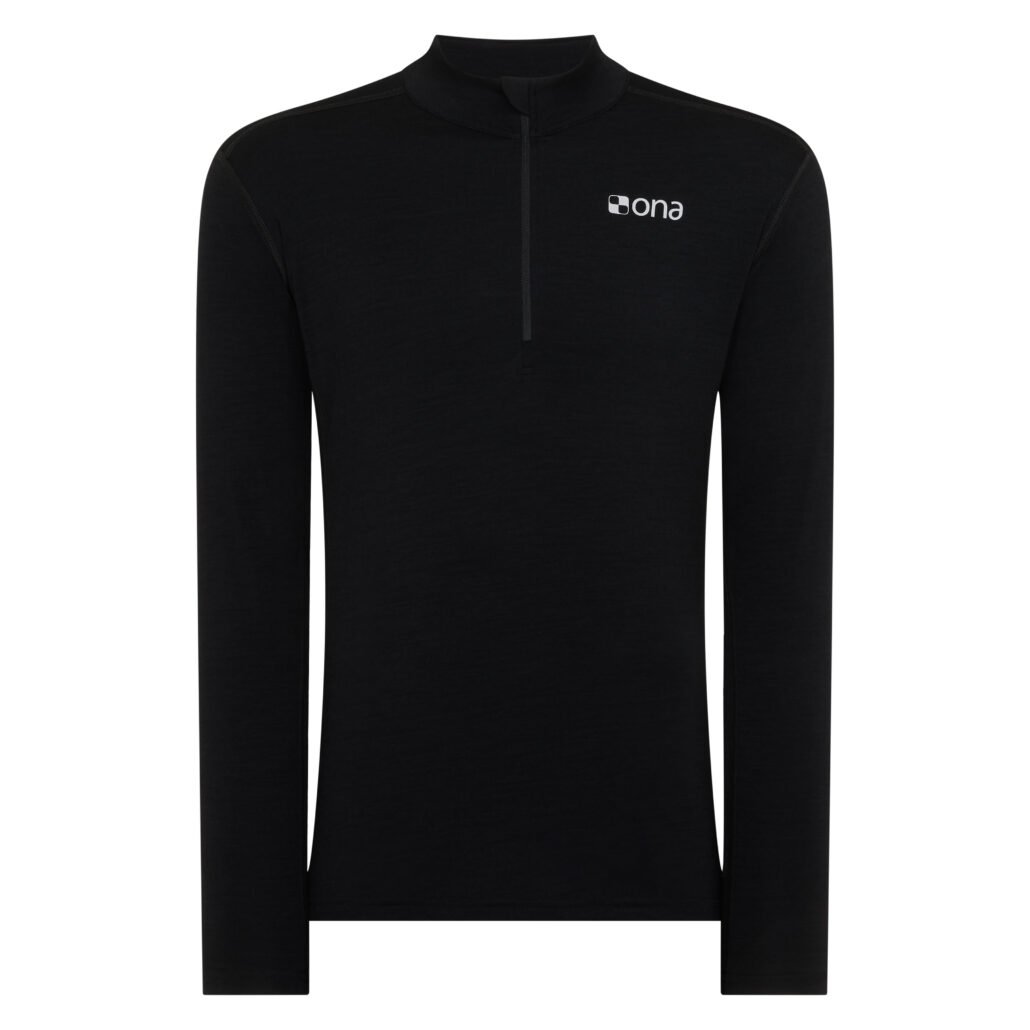
This is why performance equestrian base layers cluster at the lighter end. The Ona Polo base layer collection – Howsh for men, Quillah and Selknam for women – is built at 160g for exactly this reason: enough fabric for chilly and cool conditions worn under a shirt, light enough that it does not become the problem once you are working. Weight also behaves differently in a blend than in pure wool, because the synthetic content contributes structure and recovery rather than insulation.
Choosing a fabric weight for riding conditions
| Weight band | Typical GSM | Best suited to |
| Lightweight | 150 – 170 gsm | Active riding and polo across most of the season; the standard next-to-skin choice when a mid-layer handles insulation |
| Midweight | 200 – 250 gsm | Lower-output riding in genuine cold; winter yard work; riders who feel the cold badly |
| Heavyweight | 250 gsm and above | Static cold – spectating, grooming, travelling, early-morning yard duty |
Merino, synthetics and blends: An honest comparison
Merino is not categorically superior to engineered synthetics, and anyone claiming otherwise is selling something. The two materials solve the same problem by different means, and each wins in different conditions.
Modern technical synthetics, fine polyamide and polyester microfibres, dry faster, resist abrasion better, cost less and hold their shape through heavy laundering. For sustained high-output effort in mild conditions, or for a rider who washes kit after every session, a good synthetic is a rational choice. Merino wins on moisture buffering, on odour, on comfort across a wide temperature range, and on the specific stop-start profile that defines polo.
“We are not interested in telling players that one fabric beats every other in every condition. That is not true, and they would find out the first cold morning. What we can say honestly is which conditions we built for and where the compromises sit – we chose a blend because a garment that cannot stretch through the swing has already failed, whatever its wool content. A player who understands the trade-off makes a better choice than one who has been told there isn’t one.” – Alejandra Falkinhoff, CEO, Ona Polo
Where each material has the advantage
| Consideration | Merino wool | Technical synthetic |
| Moisture handling | Absorbs vapour into the fibre; large buffer before feeling wet | Wicks along the surface; dries faster but feels wet sooner |
| Behaviour when you stop | Buffers the cool-down; releases slight warmth as it absorbs | Rapid evaporative cooling – the post-chukka chill |
| Odour | Naturally resistant; multiple wears between washes | Requires an antimicrobial treatment, which can wash out over time |
| Durability | Softer; pure wool is more prone to pilling and wear at friction points | Excellent abrasion resistance; holds up under tack and protection |
| Stretch and recovery | Limited on its own; needs elastane to move properly | Good, particularly in knitted constructions |
| Drying time | Slower | Faster |
| Cost | Higher, reflecting fibre grade and processing | Lower |
This is why almost every serious performance base layer is a blend rather than pure wool. Adding polyamide buys abrasion resistance and structure; adding elastane buys four-way stretch and shape recovery. Ona’s collection uses 67% merino wool, 22% polyamide and 11% elastane – a deliberately higher synthetic content than a hiking base layer would carry, because a garment worn under polo whites through a full swing has to stretch in every direction and return to shape afterwards. Pure wool does not do that, and a base layer that has bagged out at the elbows by the third chukka has failed regardless of its fibre credentials.
The trade-off is real and worth stating plainly: a higher wool percentage gives a slightly larger moisture buffer and a softer handle, while a higher synthetic percentage gives mobility, durability and shape retention. For static warmth, favour the wool. For sport, the blend is the better engineering answer.
One further point belongs in any premium discussion: sourcing. Look for wool certified mulesing-free, and ideally to a recognised standard such as ZQ or the Responsible Wool Standard, with traceability back to the growing farms. Where a garment is made matters too – Ona’s base layers are knitted and finished in Italy – because consistency of gauge and seam quality is what separates a garment that holds its fit from one that does not. In this category, provenance is not decoration. It is part of what you are paying for.
Fit, cut and construction for riders
A base layer that performs brilliantly on a mountainside can fail on a horse, because the pressure points are different. Riding kit contends with a saddle, a shirt, gloves and, in polo, elbow protection and a body protector.
“A base layer for polo has to be judged with the arm extended, not standing still in front of a mirror. If it binds at the shoulder, nothing else about it matters – not the fibre, not the weight, not the price. We fit ours on players mid-swing, because that is the only position that tells you anything useful. Everything else is guesswork dressed up as a size chart.” – Alejandra Falkinhoff, CEO, Ona Polo
Crew neck or quarter-zip?
Treat this as a ventilation decision before a style one. A quarter-zip lets you dump heat quickly between chukkas or when the sun comes out mid-afternoon, and closes up to protect the throat when the wind gets up. On a variable match day it is the more useful garment, which is why the quarter-zip styles in Ona’s collection, Howsh for men and Quillah for women, are positioned as the performance option.
A crew neck is simpler, lighter and sits flatter under a fitted polo shirt. It also works as a standalone top off the yard and layers cleanly under a jacket, which makes it the more versatile garment away from the field, the reasoning behind the Selknam women’s crew neck, offered in Blossom, Mist and Lago.
If you are buying one garment for the season and you play, buy the quarter-zip. If you are buying a second, make it the crew.
Seams, sleeves and the glove interface
Look for flatlock seams, which lie flush against the skin instead of forming a ridge, and for construction that keeps seams away from the crest of the shoulder, the exact spot where a shirt strap, a body protector or a swing will rub. Four-way stretch fabric matters here too: a garment that stretches only along one axis will pull somewhere when your arm goes above your head.
Sleeves should be long enough to stay put when the arm extends fully, and slim enough at the wrist to sit cleanly inside a glove cuff without bunching. Bunched fabric at the wrist compromises the one connection that matters most in this sport: the feel between hand, rein and mallet. Riders who already know the difference a well-fitted glove makes will recognise the same principle at work here.
Sizing
A base layer should sit as a second skin: close enough that the fabric is in contact with the skin across its whole area, because moisture transfer depends on that contact. Loose fabric does not manage sweat, it hangs, and it bunches under the saddle or at the knee.
That said, a slim performance fit is cut close by design, and most equestrian brands, Ona included, recommend sizing up if you fall between sizes. The garment should feel snug rather than compressive. If you have to work to get into it, or if it restricts a full arm extension, it is too small, and no amount of stretch will fix that over four chukkas.
Building a layering system for the season
In the UK, arena polo runs broadly from October through March, which is exactly the window in which layering stops being optional. The US season varies widely by region, but the principle holds anywhere the temperature moves more than a few degrees across a match day.
Think in three parts. The base layer manages moisture. The mid-layer traps warmth and comes off before you play. The outer layer stops wind and rain and lives on the back of the car until you need it. The single most common error is asking one garment to do two of those jobs, usually by buying a base layer heavy enough to serve as insulation, which then cannot be removed once you are on a pony.
Practical layering by condition
| Conditions | Suggested setup |
| 12–18°C, spring practice | Lightweight merino base under the team shirt; nothing else needed once you are warm |
| 5–12°C, autumn chukkas | Lightweight quarter-zip under the shirt; light fleece or gilet between chukkas, removed to play |
| 0–5°C, winter arena polo | Lightweight base layer, shirt, insulating mid-layer for the interval, windproof shell off-pony |
| Below freezing, stick-and-ball | Base layer plus a mid-layer worn throughout and a windproof outer; gloves are the limiting factor, not the torso |
Two practical notes. First, put the mid-layer back on the moment you dismount, not once you start feeling cold – by then the moisture in your base layer has already begun working against you. Second, the extremities fail before the core does. A perfect torso system will not rescue cold hands, which is why glove selection deserves as much thought as anything described above.
Care: Superwash, hand wash, and making a base layer last
Merino’s reputation for fragility is largely a reputation for being washed badly. Treated correctly, a good base layer will run for several seasons. But there is one distinction that almost no buyer is told about, and it determines how much care the garment actually needs.
“Most base layers we see written off were not worn out. They were washed to death – hot cycles, biological detergent, fabric conditioner, a tumble dryer on a Sunday night. Merino is not fragile, but it is a protein fibre and it has opinions about how it is treated. Get the washing right and the garment will comfortably outlast the kit you wear over it.” – Alejandra Falkinhoff, CEO, Ona Polo
Superwash and non-superwash merino – the distinction that matters
Untreated wool fibre is covered in microscopic scales. Under heat and agitation those scales interlock and the fabric felts – which is how a wool garment comes out of a hot wash two sizes smaller. Superwash is a finishing process that smooths or coats those scales so the fibre can no longer felt, making the garment fully machine washable without shrinkage or loss of shape.
The trade-off is subtle. Superwash wool is more robust and vastly more practical for kit that gets worn hard and washed often. Non-superwash wool keeps the fibre in its natural state, which some people may find softer and finer against the skin, but it requires gentler handling.
You will find both in a well-considered collection, and the choice usually maps to how the garment is meant to be used. Ona’s quarter-zip styles, Howsh and Quillah, use superwash merino and go straight into a 30°C wool cycle, the right answer for a garment that comes off muddy after a tournament. The Selknam crew neck uses a non-superwash merino, asks for a mesh bag on a wool cycle or a hand wash in lukewarm water with a wool-specific detergent.
Before you buy, it is worth knowing which you are getting. Before you wash, it is essential.
Universal rules for any merino base layer
- Wash cool – 30°C on a gentle or wool cycle. Heat and agitation are what damage wool.
- Use a mild or wool-specific detergent. Avoid biological and enzymatic products, which attack protein fibre.
- Never use fabric conditioner. It coats the fibre and undoes the moisture management you paid for.
- Never bleach.
- Never tumble dry. Lay flat to dry, away from direct heat and strong sunlight.
- Cool iron on the reverse only if genuinely needed.
- Store folded rather than hung – knitted wool stretches on a hanger – and store clean, with moth protection.
- De-pill gently with a fabric comb or shaver rather than pulling at the bobbles.
Because merino resists odour, it also needs washing less often than a synthetic equivalent. Airing a garment overnight between sessions is frequently enough, and every wash you skip is a small extension of its working life.
Common mistakes, and what to buy first
If you are buying your first proper base layer, the decisions that matter are narrower than the market suggests.
Four mistakes worth avoiding
- Wearing cotton underneath. Cotton absorbs sweat, holds it against the skin and does not release it. It is the single worst choice for interval sport in cold weather, and it is still the most common one.
- Buying too heavy. Riders shop for how cold they feel standing still and then overheat in the first chukka. Dress so that you are slightly cold before you start.
- Buying too loose. A base layer worn loose is a shirt, not a base layer.
- Ignoring the numbers. A garment that will not tell you its fibre content, its weight or how to wash it is asking you to take its performance on trust.
A sensible first purchase
Fine merino in a blend with a meaningful elastane content, somewhere around 150 to 170 grams, with flatlock seams and a slim athletic cut. A quarter-zip if you play through a variable season; a crew if you want the flattest possible line under a fitted shirt and a garment you will also wear off the yard.
Own two rather than one – not for warmth, but because a tournament weekend rarely leaves time for laundry. And check the care label before you commit: a superwash garment you can machine wash on Sunday night is a materially different proposition from one that needs a hand wash and a day to dry flat.
“The best kit is the kit you stop thinking about. That is the whole standard, really – you should not be aware of what is against your skin while you are playing, only afterwards, when you notice you are still comfortable. If a player comes back and tells us nothing about a garment except that they wore it all winter, we have done the job properly.” – Alejandra Falkinhoff, CEO, Ona Polo
A base layer is the least visible piece of kit a polo player owns and, for anyone riding through a winter season, one of the most consequential. It sets the conditions everything else works within: whether you come out of the fourth chukka warm or shaking, whether your shoulder moves freely through the swing, whether your kit bag smells like a kit bag by Sunday afternoon.
Merino earns its place in that role not because it is a luxury material, though the finest grades certainly are, but because its physics happen to match the shape of the sport. It buffers moisture instead of shedding it. It releases a little warmth at the moment you stop moving. It tolerates being worn again the next morning. Those are unglamorous virtues, which is exactly why they are worth understanding properly before you spend.
Choose by fibre quality and by weight rather than by claim. Insist on a cut that respects the shoulder and a fit you can extend fully in. Check whether the wool is superwash before you decide how much care you are willing to give it. Then wash it cool, keep the fabric conditioner away from it, and it is a decision you will not have to revisit for several seasons.
Frequently asked questions
Can you wear a base layer under a polo shirt in competition?
Yes. Governing body regulations concern the team shirt itself, its colours, its uniformity across the team and the player’s number, rather than what is worn beneath it. No rule restricts base layers. As a matter of courtesy rather than regulation, a neutral or dark under-layer avoids clashing with team colours where the collar or cuff is visible.
Are merino base layers worth it for riding?
For cold-weather and interval-based riding, generally yes. The advantage over a synthetic is most pronounced in exactly the conditions polo creates: heavy sweating followed by standing still in the cold. For mild-weather, steady-output riding, a good synthetic performs comparably at lower cost.
Are base layers better than thermals?
They are different garments. A thermal is designed for insulation while static. A base layer is designed to move moisture during activity. For riding, the base layer is the correct starting point, with insulation added as a separate mid-layer.
Does merino wool smell?
Far less than synthetic fabric. Merino absorbs and traps the compounds that cause body odour, and its surface is less hospitable to odour-forming bacteria. It is odour-resistant rather than odour-proof, and it still requires regular washing.
What micron merino is best against the skin?
Between 17.5 and 19.5 microns suits most riders. Below 17.5 is softer still but commands a premium and wears faster; above roughly 22 microns, some wearers begin to feel prickle.
Does merino wool itch?
Fine merino should not. The itch associated with wool comes from coarse fibre ends pressing into the skin rather than bending away, which is a function of fibre diameter. Modern superfine merino sits well below that threshold.
How often should a merino base layer be washed?
Less often than a synthetic. Airing it overnight is usually sufficient between sessions; wash it when it is genuinely soiled rather than by routine, and it will last considerably longer.
Is a 160g base layer warm enough for winter?
As a next-to-skin layer, yes, provided you treat it as part of a system rather than as the whole answer. A lightweight base layer manages moisture during activity; insulation comes from the mid-layer you add between chukkas and remove before you play. A heavier base layer worn during exercise usually causes more problems than it solves.